


AI & Work
Cognizant, the Teaneck, N.J.-based technology services company, ended September with 359,900 employees, 10,100 more than a year earlier, even as its chief executive said more than half of the company’s software code is now written with help from artificial intelligence. The figures come from the third-quarter results Cognizant released on Thursday, Oct. 29, and filed with the Securities and Exchange Commission.
Headcount rose by 3,200 from the end of June, the company said. Trailing-12-month voluntary attrition in its tech services business was 12.6%, down from 13.0% for the period ended June 30 and unchanged from a year earlier.
AI adoption without a smaller payroll
Chief Executive Ravi Kumar S framed the quarter around AI. “The AI market is moving from capability to value realization, requiring enterprises to reimagine how work gets done,” he said in the release, adding that the company is making that transition “with over 50% of our code now AI-assisted” and that its associates have earned more than 95,000 “frontier AI badges and certifications.” He also pointed to “continued improvement in revenue and adjusted operating income per employee.”
That last measure is the one to watch for workers. Revenue grew 4.6% from a year earlier to $5.66 billion, while headcount grew about 2.9%, meaning each employee is generating more revenue. So far, at Cognizant, that productivity gain has come alongside a larger workforce rather than a smaller one.
The company also gave a specific example of what AI-assisted delivery looks like. In work for Odyssey Logistics, a seven-person Cognizant team used Cognition’s AI software engineer, Devin, to handle a legacy conversion; Cognizant said delivery throughput rose by roughly a third and Odyssey recorded a 37% net cost saving against the conventional approach.
Severance alongside hiring
Cognizant is also paying to reshape its workforce. Under Project Leap, a program introduced in the second quarter to fund investments in AI capabilities and partnerships and to upskill employees, the company now expects total costs of $180 million to $250 million. Of that, $150 million to $200 million is employee severance and other personnel-related costs, with $140 million to $160 million of the total expected in 2026 and the rest through the first quarter of 2027. The release does not say how many positions the severance covers.
Hiring and training plans
The release lists several workforce commitments. Cognizant said it plans to hire 1,500 U.S. college graduates and to scale a workforce of “Frontier Certified Engineer” and “Frontier Business Operator” staff to 15,000 people, backed by annual direct hiring from universities. It said it held an Americas hackathon with OpenAI in which more than 2,600 employees built solutions using OpenAI Codex, following a 10,000-participant event in India in late July. It also said it formed a Gemini Frontier Capability Group with Google Cloud backed by 18,000 dedicated Cognizant associates.
For job seekers in IT services, the picture is a sector still hiring, but increasingly around AI credentials. Cognizant’s own language ties its U.S. graduate hiring and its certified-engineer workforce to AI skills, and the 95,000 badges figure suggests internal certification is becoming a routine part of the job.
Caveats
The headcount figure is companywide and is not broken out by country, so the release does not show how many of the additional 10,100 employees are in the United States. The graduate-hiring and 15,000-person workforce targets are plans, not completed hires, and the release gives no timeline for them. Third-quarter bookings fell 7% from a year earlier, although trailing-12-month bookings rose 4% to $28.7 billion. Cognizant forecast fourth-quarter revenue of $5.49 billion to $5.57 billion.
Sources
- Cognizant, “Cognizant Reports Third Quarter 2026 Results,” Exhibit 99.1 to Form 8-K, October 29, 2026. https://www.sec.gov/Archives/edgar/data/1058290/000105829026000039/exhibit9919302026.htm
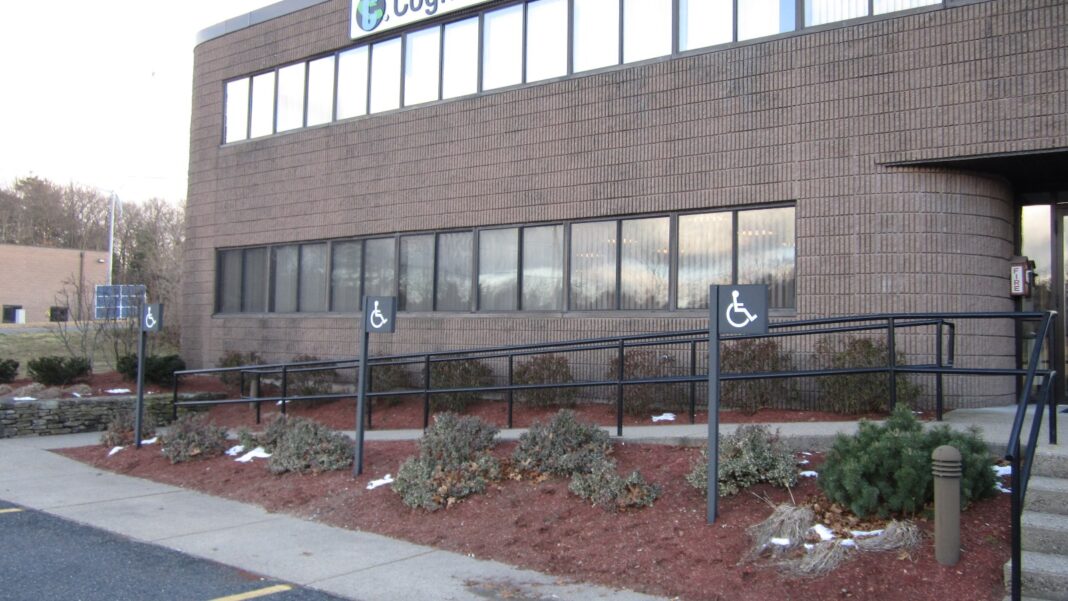
Featured photo: Cognizant's Global Delivery Center in Massachusetts, photographed in January 2012. Photo: Cognizant, via Wikimedia Commons (CC BY-SA 2.0). Cropped from the original.