
Whether artificial intelligence is separating large employers from small ones is no longer a question that has to be argued from anecdotes. The U.S. Census Bureau’s Business Trends and Outlook Survey (BTOS) asks a nationally representative sample of businesses every two weeks whether they used AI “in any of its business functions” during the prior two weeks, and whether they expect to use it in the next six months. The Bureau publishes the answers by employment size class.
The most recent cycle in the Bureau’s size-class file covers a reference period of August 10–23, 2026, with responses collected August 24 through September 6 and published September 10. It shows a clear step up in reported AI use among the largest employers and a much flatter picture below them. The short version: larger firms are more likely to report using AI, but the gap opens mainly at 100 employees and above rather than rising evenly with every added worker.
What the Census numbers show
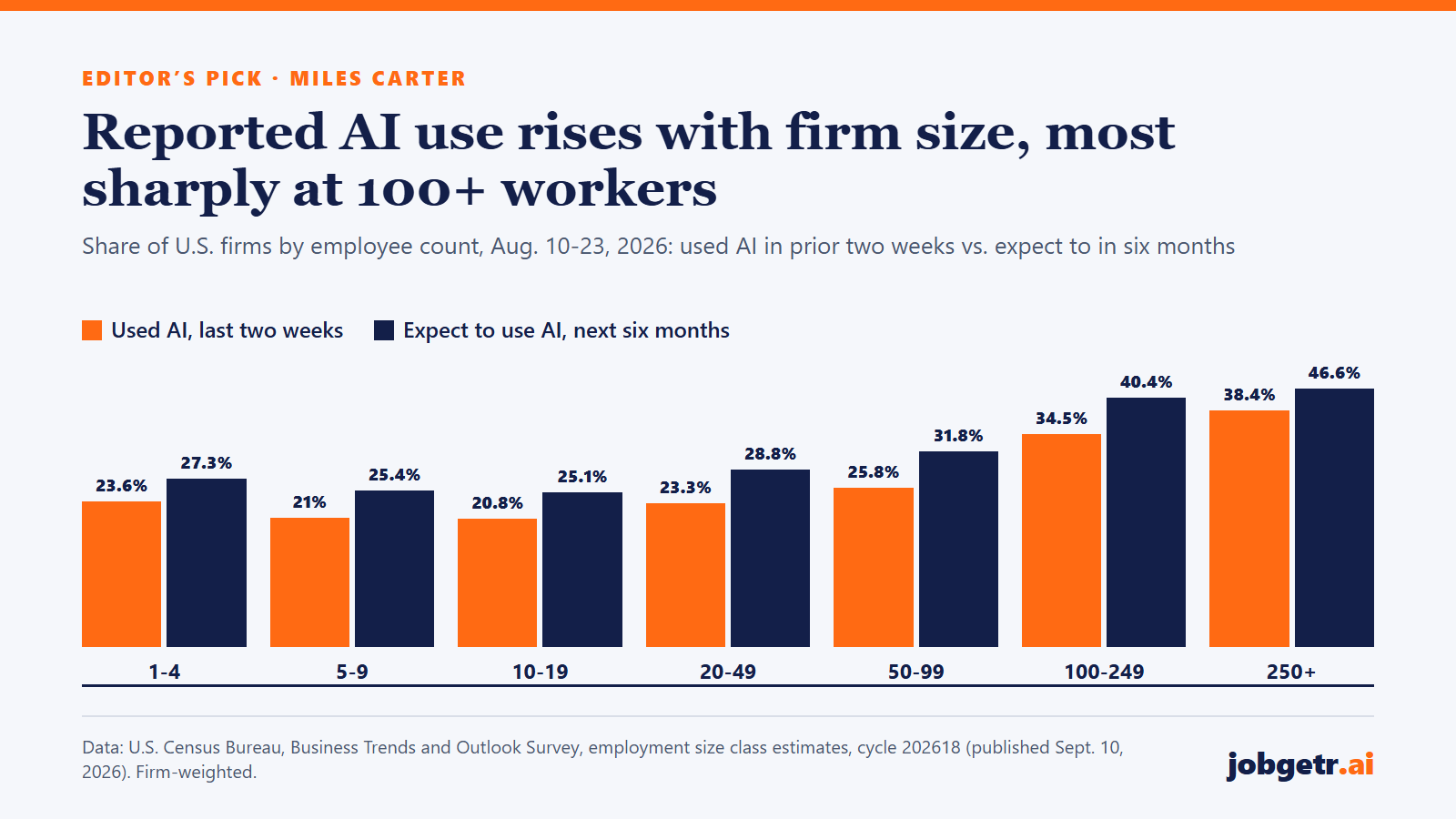
In that cycle, 38.4% of firms with 250 or more employees and 34.5% of firms with 100 to 249 employees said they had used AI in the previous two weeks. Below 100 employees, reported use sat in a narrow band: 23.6% for firms with 1 to 4 employees, 21.0% for 5 to 9, 20.8% for 10 to 19, 23.3% for 20 to 49 and 25.8% for 50 to 99. Across all firms, the national estimate was 23.2%.
Expectations follow the same shape. In the same cycle, 46.6% of the largest firms and 40.4% of firms with 100 to 249 employees said they expected to be using AI within six months, compared with 25.1% to 31.8% for each size class below 100 employees.
The Bureau’s own analysis points in the same direction. A May 26, 2026 Census story covering December 2025 through early May 2026 reported that 37% of firms with at least 250 employees and 32% of firms with 100 to 249 employees used AI in the collection period ending May 3. It found that AI use rose over those months among firms with at least 20 employees but “didn’t change significantly among firms with fewer than 20 employees.”
An April 2026 Census working paper by Kathryn Bonney and co-authors, drawing on a detailed AI supplement to the survey with a November 2025 to January 2026 reference period, found that 18% of firms used AI in a business function, rising to 32% when firms are weighted by employment. Use rates reached 50% to 60% for very large firms in the Information, Professional Services and Finance sectors. In that supplement period, the paper reports, current use was about 31% for firms with 250 or more employees and around 18% for firms under 20 employees.
The employment-weighted figure matters for workers. Large employers account for a disproportionate share of jobs, so the share of workers at AI-using firms is much higher than the share of firms using AI. The same paper notes that about 75% of U.S. firms have fewer than 10 employees, which helps explain why firm-counted adoption rates look low next to surveys that sample mainly larger companies.
What the data do not show
The size gradient is real in these estimates, but several limits keep it from supporting a stronger claim that AI is creating a new or widening divide.
- The question changed. On November 17, 2025, the Bureau revised its core AI questions to ask about use in any business function. The working paper describes a significant upward level shift across all size classes after the change, so earlier and later estimates cannot be joined into one trend.
- Uncertainty rises with size. In the August cycle, 24.5% of the largest firms answered “do not know,” compared with 8.5% of firms with 1 to 4 employees. The published standard error for the 250-plus estimate was 2.58 percentage points, against 0.47 for the smallest class. Swings from one two-week cycle to the next at the top end should not be read as trends.
- Use is not depth. The survey records whether a firm used AI, not how much. The working paper found that 57% of AI-using firms apply it in three or fewer business functions.
- Respondents are firms, not workers. Answers typically come from an owner, manager or executive. The paper cautions that decentralized use by individual employees may be under-reported.
- It is national. These estimates say nothing specific about Atlanta or any other metro area.
One more nuance cuts against a simple “small firms are falling behind” story. Reported use among firms with 1 to 4 employees stood at 19.0% in the cycle ending May 3 and at 23.6% in the August cycle. We have not seen a Census significance test for that change, so it is best treated as something to watch rather than a finding.
What it means for employers and workers
For small employers, the working paper suggests the gap is not only about budgets. Among firms not planning to use AI in the near term, the most common reason given was that AI is not applicable to the business (65%), followed by lack of knowledge of AI’s capabilities (22%) and privacy or security concerns (20%). Those are questions a small firm can answer for itself: which specific workflow, if any, would benefit, what data it would touch, and how the owner would tell whether the result was better.
For larger employers, the forward-looking numbers matter more than the current gap. In the supplement period, the paper found firms with 100 to 249 employees expected use to rise to 34% from 25%, and the largest firms to 40% from 31%, while the smallest firms expected only a small increase, to about 21% from 18%. Expectations are not investment decisions, but they suggest larger organizations are planning for more AI in their operations.
For workers and job seekers, the practical point is exposure rather than ranking. A worker at a large employer is more likely to encounter AI tools on the job, which makes familiarity with them more relevant in those hiring processes. That is a statement about probability across employers, not a prediction about any single company.
What to watch next
The BTOS core questions are released every two weeks, so the size-class series will show within months whether the recent rise among the smallest firms holds. The working paper also notes that the Bureau is planning questions on AI’s effects on hiring for the next AI supplement, pending approval from the Office of Management and Budget. Hiring effects by firm size would be the evidence needed to say whether differences in adoption are translating into differences in employment.
Sources
- U.S. Census Bureau, “Business Trends and Outlook Survey (BTOS), response estimates by employment size class (cycle 202618, reference period Aug. 10-23, 2026; published Sept. 10, 2026; file retrieved Sept. 24, 2026),” 2026-09-10. https://www.census.gov/hfp/btos/downloads/Employment%20Size%20Class.xlsx
- U.S. Census Bureau, “Business Trends and Outlook Survey (BTOS), national response estimates (cycle 202618; published Sept. 10, 2026; file retrieved Sept. 24, 2026),” 2026-09-10. https://www.census.gov/hfp/btos/downloads/National.xlsx
- U.S. Census Bureau, “Large Firms With at Least 20 Employees Biggest AI Users (Adam Grundy, Cory Breaux, Dhanapati Khatiwoda),” 2026-05-26. https://www.census.gov/library/stories/2026/05/ai-use-businesses.html
- U.S. Census Bureau, Center for Economic Studies, “The Microstructure of AI Diffusion: Evidence from Firms, Business Functions, and Worker Tasks (CES-WP-26-25; Bonney, Breaux, Dinlersoz, Foster, Haltiwanger, Pande),” 2026-04. https://www.census.gov/library/working-papers/2026/adrm/CES-WP-26-25.html
Featured photo: U.S. Census Bureau headquarters in Suitland, Maryland (2007). The Bureau's Business Trends and Outlook Survey is the source of the firm-size data. Photo: United States Census Bureau / Oficina del Censo de los Estados Unidos, via Wikimedia Commons (Public domain). Resized from the original.