
Will generative AI narrow pay differences between workers or widen them? It is one of the most common questions in compensation planning right now, and the honest answer for 2026 is that the evidence does not yet say. What recent research does show is where to look, and why the first effects may not appear in wage data at all.
This piece treats compression and widening as open questions. Neither has been measured as a 2026 outcome in the sources reviewed here.
What the newest research actually measures
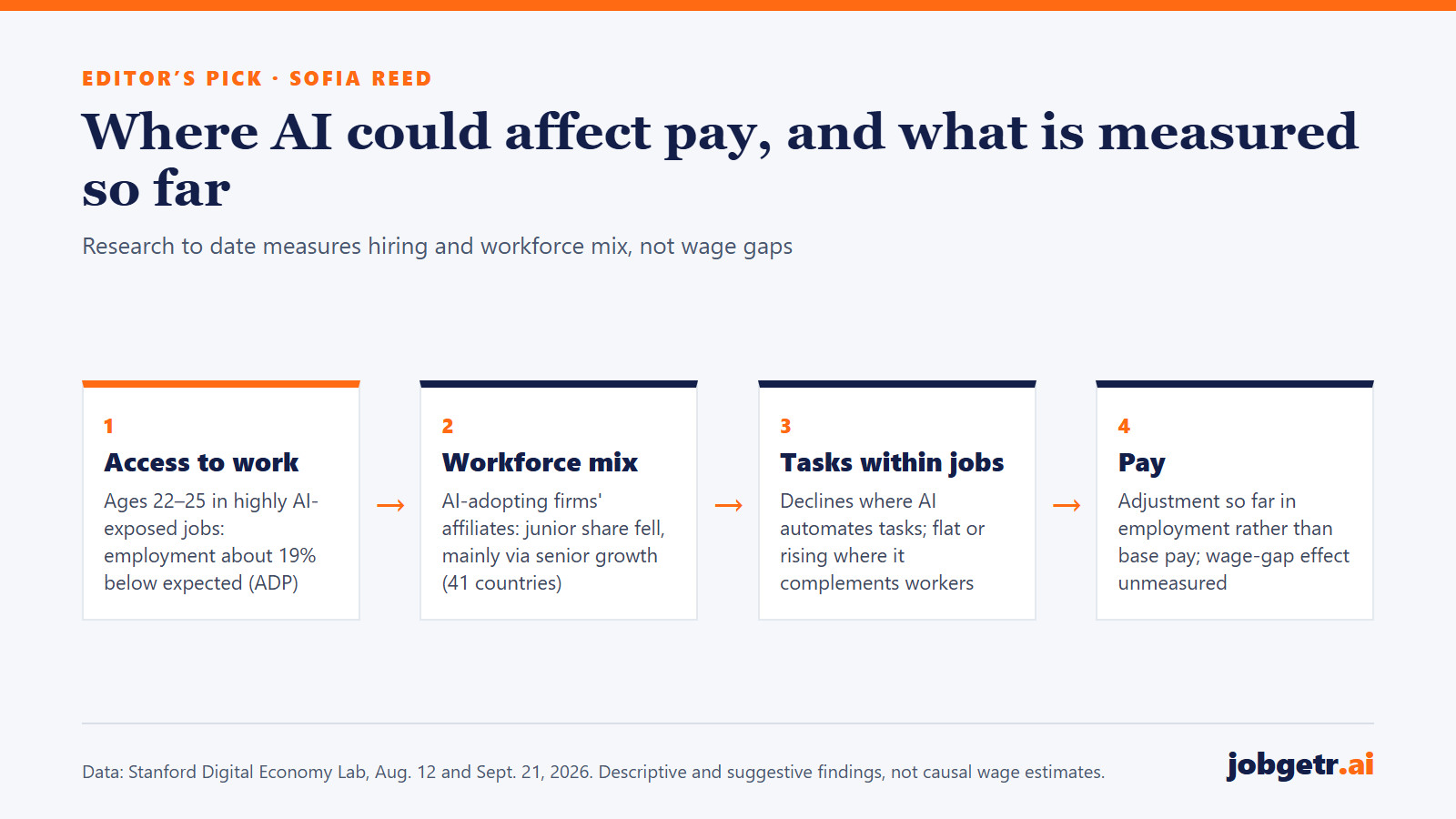
In August, researchers at the Stanford Digital Economy Lab, Erik Brynjolfsson, Bharat Chandar and Ruyu Chen, updated their analysis of ADP payroll data through June 2026. They found that employment of workers ages 22 to 25 in highly AI-exposed occupations was about 19% below what would be expected relative to less-exposed peers, a gap that had widened from 15% in July 2025. They reported that “experienced workers show no comparable gap” and that the adjustment is happening “primarily through reduced hiring of young workers rather than increased separations.”
On pay, the finding is specific: “So far, adjustment is showing up primarily in employment rather than base pay.” The authors note that base pay excludes bonuses, equity and other variable pay. In the full paper, they report finding little difference in base-pay trends by age or by exposure level; the 19% figure is an employment gap, not a pay gap.
The authors are careful about interpretation. They describe their results as “descriptive patterns, not causal estimates,” note that gaps shrink when controlling for education, that some trends predate generative AI, and that estimates are larger in the ADP sample than in national survey benchmarks. They also state: “We do not see widespread, economy-wide job displacement associated with AI.”
A September working paper from the same lab, by Chandar and Bouke Klein Teeselink, takes an international view. Using 1.25 billion job postings and 154 million employment records across 41 countries, and inferring AI adoption from job advertisements involving generative-AI use, it finds that foreign affiliates of AI-adopting firms reduced the junior share of their workforce relative to comparable affiliates. That shift came mainly from growth in senior employment rather than a fall in junior employment, with suggestive evidence of modest overall employment growth and modest productivity gains. Senior employment shifted toward AI-exposed occupations; the point estimates suggest juniors shifted away from them. The paper does not report wage effects.
Why the pay effect may be hiding
If AI is changing who gets hired before it changes what people are paid, standard wage statistics could miss the early stage entirely. Three channels are worth separating:
- Access to work. Fewer entry-level hires in exposed occupations reduces the number of young workers earning those occupations’ wages, without changing the wage itself.
- Tasks within jobs. Where AI automates tasks, demand for some roles may fall; where it complements workers, the Stanford analysis found employment flat or rising. Either can change what a job is worth over time.
- Pay for incumbents. Workers who remain employed may see their pay move differently from new entrants, which only matched, individual-level data can show.
This is where the question of compression versus widening becomes ambiguous. A thinner junior pipeline could raise pay for the juniors who are hired if they are scarce, or reduce it if employers need fewer of them. More senior hiring in AI-exposed roles could lift senior pay, or spread similar pay across more people. The published evidence does not choose among these.
A composition effect adds another trap. If fewer low-paid entry-level workers are on payrolls, average pay in an occupation can rise even if no individual gets a raise. A reported “wage premium” for AI-exposed work could partly reflect who was not hired.
The aggregate backdrop
Aggregate data are no help in attributing effects to AI, but they frame the question of who is capturing productivity gains. The Bureau of Labor Statistics reported that nonfarm business labor productivity rose 1.4% at an annualized rate in the second quarter of 2026 and 2.2% over four quarters. Real hourly compensation fell 0.1% over the same four quarters, and the labor share of output was 52.8%, “the lowest level in the series, which begins in the first quarter of 1947.”
That is a statement about the whole nonfarm business sector, not about AI. Many forces move labor share. But it does mean that any argument about AI and wage gaps is taking place against a period in which productivity has grown faster than real hourly compensation.
What employers and workers can do with an open question
For compensation teams, the practical task is measurement, not prediction. Useful steps include:
- Tracking entry-level requisitions, offers and hires in AI-exposed roles separately from pay benchmarks.
- Separating pay changes for incumbents from changes in who is hired.
- Breaking analyses out by age or experience, occupation and geography rather than relying on a single average.
- Labeling which figures are observed outcomes and which are research hypotheses.
For early-career workers, the research points to access as the first pressure point, not starting pay. The pay a posting advertises matters less if fewer such postings are filled by new entrants.
What to watch next
The clearest public signal would come from matched-worker wage data broken out by career stage and pay level. The Atlanta Fed’s Wage Growth Tracker already publishes series by age group and by wage quartile. If AI were compressing or widening pay, divergence in those series would be one place to see it, though any divergence could have other causes. Further updates of the Stanford payroll analysis that add pay outcomes would also help. Until then, the defensible position is that AI’s visible labor-market effect so far is in hiring, not in wages.
Sources
- Stanford Digital Economy Lab (Erik Brynjolfsson, Bharat Chandar, Ruyu Chen), “No Widespread Displacement, but the AI Employment Gap for Young Workers Has Widened to 19%,” August 12, 2026. https://digitaleconomy.stanford.edu/news/canariesaug26/
- Stanford Digital Economy Lab (Bharat Chandar, Bouke Klein Teeselink), “How Does AI Change Labor Demand? Evidence from 41 Countries,” September 21, 2026. https://digitaleconomy.stanford.edu/publication/how-does-ai-change-labor-demand/
- U.S. Bureau of Labor Statistics, “Productivity and Costs, Second Quarter 2026, Revised,” September 3, 2026. https://www.bls.gov/news.release/prod2.nr0.htm
- Federal Reserve Bank of St. Louis (FRED), “Search results: Unweighted Median Hourly Wage Growth (Atlanta Fed Wage Growth Tracker series),” accessed September 24, 2026. https://fred.stlouisfed.org/searchresults/?st=Unweighted%20Median%20Hourly%20Wage%20Growth
Featured photo: Participants at a 2022 hackathon. Representative image of early-career technology work. Photo: Ciell, via Wikimedia Commons (CC BY-SA 4.0). Resized from the original.