



Federal workforce policy has now put a definition on a phrase that was vague not long ago. In February the Department of Labor published an AI Literacy Framework that treats AI literacy as a foundational skill for workers in any occupation, not a specialty for technologists. Business survey data show AI adoption is real but far from universal. The distance between those two things is where training programs, employers and job seekers need to be careful.
What the framework says
Training and Employment Notice 07-25, issued February 13, 2026, released the framework as a resource for program design across the public workforce and education systems. It is voluntary guidance. DOL defines AI literacy as “a foundational set of competencies that enable individuals to use and evaluate AI technologies responsibly, with a primary focus on generative AI.”
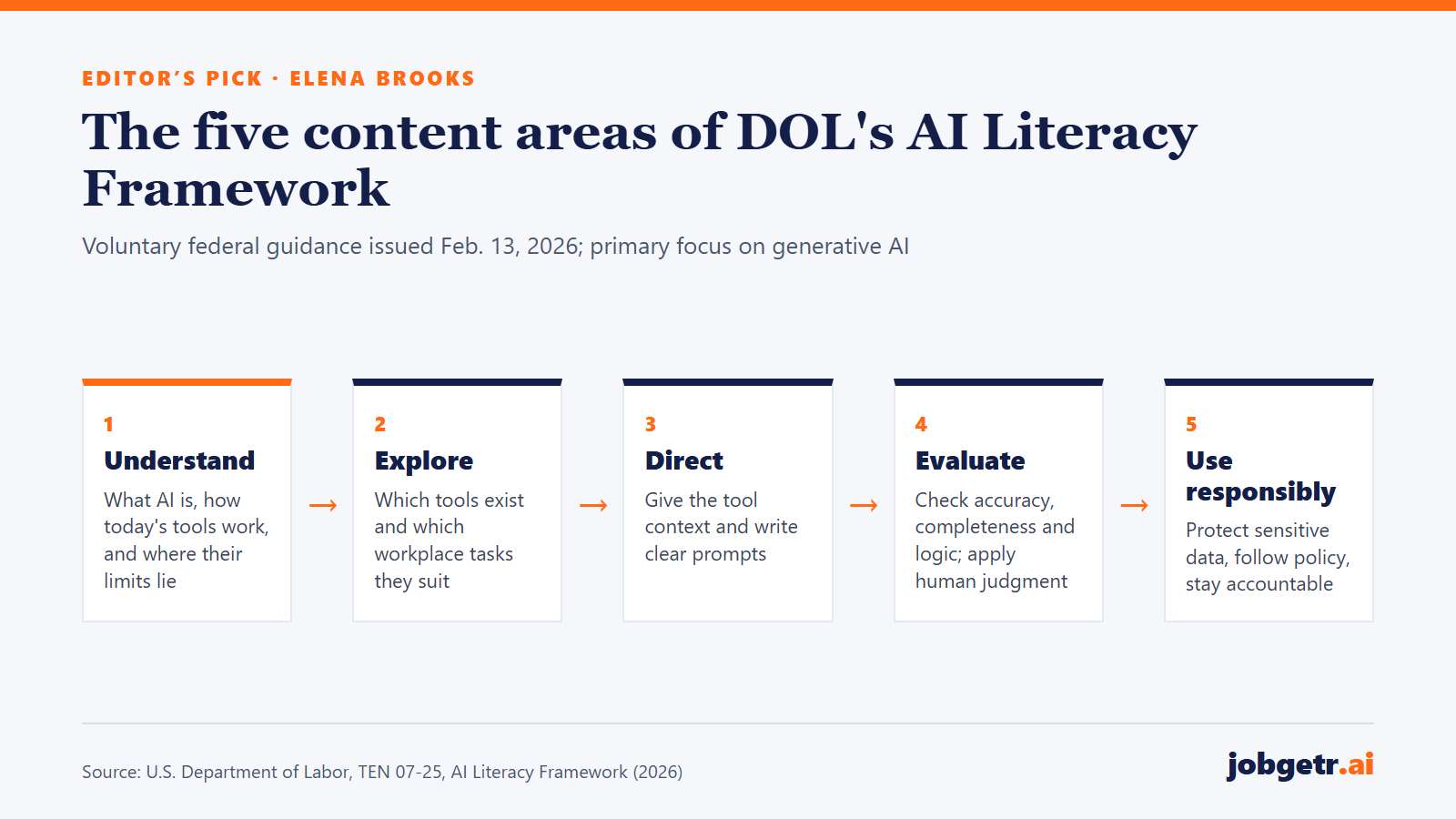
The framework organizes that definition into five content areas:
- Understand AI principles: what AI is, how today’s tools work and where their limits lie.
- Explore AI uses: the tools available and the tasks they suit.
- Direct AI effectively: giving a tool context and writing clear prompts.
- Evaluate AI outputs: checking accuracy, completeness and logic, and applying human judgment.
- Use AI responsibly: protecting sensitive information, following workplace policy and staying accountable for results.
It adds seven delivery principles, among them experiential learning, embedding learning in the context of a job, addressing prerequisites such as digital literacy, preparing managers and trainers, and designing programs to change as the tools change.
Two passages deserve attention. The framework states that “every worker will need baseline AI literacy skills to succeed, regardless of industry or occupation.” That is a policy judgment about where the economy is heading, not a measurement of what jobs require today. The framework also cautions that in most workplaces “indicating a need for ‘AI literacy’ is not enough on its own,” and that employers may need to define the specific skills and proficiency appropriate for each role.
The content itself supports the idea that this is a general workforce skill rather than a technology skill. Two of the five areas, evaluating outputs and responsible use, are about verification, judgment and data handling rather than technical operation. Those skills travel across functions in a way that coding or model-building does not.
What adoption data show
The Census Bureau’s Business Trends and Outlook Survey, a biweekly, nationally representative survey, asks whether businesses used AI in any business function in the previous two weeks. In a May 26 analysis of data collected from December 14, 2025, to May 3, 2026, Census reported that overall AI use hovered between 17% and 20% of businesses, and that 20% to 23% expected to be using it within six months.
Use varied sharply. Among firms with at least 250 employees, 37% reported using AI. In the collection period ending May 3, 32% of firms with 100 to 249 employees did. Fewer than 20% of firms with four or fewer employees reported using it. By sector, the use rate was 39.7% in Information and 33.9% in Finance and Insurance, compared with a national rate of 19.8%; Retail Trade was around 14%.
Earlier Census evidence cautions against assuming that adoption automatically reshapes skills. In the 2023 Annual Business Survey, covering 2020 to 2022, most businesses said technologies including AI had little or no impact on worker skill levels. Only 3.3% of businesses using AI reported that worker skill levels decreased, and AI was the technology businesses most often cited as positively affecting skill levels.
Put together: roughly one business in five reports using AI in some function, and large firms and information-intensive sectors are well above that. For many workers, AI is already part of the job. For many others, especially at small firms, it is not yet.
Where job postings fit
Researchers are starting to track AI demand through job advertisements. A Stanford Digital Economy Lab working paper released September 21, drawing on 1.25 billion job postings and 154 million employment records across 41 countries, inferred firms’ AI adoption from job ads involving generative-AI use. It found that the junior share of the workforce fell at foreign affiliates of AI-adopting firms relative to control affiliates, driven mainly by growth in senior employment rather than shrinking junior employment. The estimates are observational, and a posting signals demand; it is not a completed hire.
What none of these sources provides is a measured, economy-wide count of jobs that require AI literacy today. We therefore do not claim one. The honest description is that AI literacy is being defined as a general skill by policy, while measured business adoption remains partial and uneven.
What employers, trainers and workers can do
For employers, the framework’s own advice is the practical one: decide which roles need what level of AI skill, write it down and give staff clear internal rules on appropriate use. A requirement that says only “AI literacy” tells a candidate little and gives a hiring manager nothing to assess.
For training providers, the content areas point toward measuring what a learner can do, such as catching an error in an AI-generated summary or recognizing information that should not be entered into a tool, rather than counting course completions.
For workers, the most transferable pieces are the least technical: verification, judgment and careful handling of information. They are useful whether an employer adopts AI this year or later, and they are distinct from the occupation-specific technical credentials needed to build or manage AI systems.
What to watch next: the Census AI supplement, which now measures use across 15 business functions and asks about related changes such as training and workflow adjustments; DOL’s revisions to a framework it says will evolve; and whether employers begin describing AI skills in postings by role rather than under a single label.
Sources
- U.S. Department of Labor, Employment and Training Administration, “Training and Employment Notice No. 07-25: The U.S. Department of Labor’s Artificial Intelligence Literacy Framework,” February 13, 2026. https://www.dol.gov/agencies/eta/advisories/ten-07-25
- U.S. Department of Labor, “US Department of Labor releases AI literacy framework providing foundational content areas, delivery principles to guide nationwide efforts,” February 13, 2026. https://www.dol.gov/newsroom/releases/eta/eta20260213
- U.S. Census Bureau, “Large Firms With at Least 20 Employees Biggest AI Users,” May 26, 2026. https://www.census.gov/library/stories/2026/05/ai-use-businesses.html
- U.S. Census Bureau, “How AI and Other Technology Impacted Businesses and Workers,” September 17, 2025. https://www.census.gov/library/stories/2025/09/technology-impact.html
- Stanford Digital Economy Lab, “How Does AI Change Labor Demand? Evidence from 41 Countries (working paper, Bharat Chandar and Bouke Klein Teeselink),” September 21, 2026. https://digitaleconomy.stanford.edu/publication/how-does-ai-change-labor-demand/
Featured photo: The Frances Perkins Building in Washington, D.C., headquarters of the U.S. Department of Labor, which issued the AI Literacy Framework. Photo: ajay_suresh, via Wikimedia Commons (CC BY 2.0). Resized from the original.





.jpg)