



A popular argument in workforce circles holds that the bachelor’s degree is losing its grip on good jobs. The evidence available today supports a narrower and more useful claim. The degree still carries a large earnings and employment advantage on average. At the same time, one very large employer, the federal government, is rewriting its rules so that a degree is required only where a job legally demands it, and skills are tested directly.
Those facts are not in tension. One describes what workers with different credentials earn; the other describes how an employer decides who is qualified.
What the earnings data show
The Bureau of Labor Statistics’ “Education pays” table, last updated September 1, reports that full-time wage and salary workers age 25 and over whose highest credential was a bachelor’s degree had median usual weekly earnings of $1,578 in 2025. Workers whose highest credential was a high school diploma had median weekly earnings of $966. That is a gap of $612 a week; bachelor’s degree holders earned about 63% more.
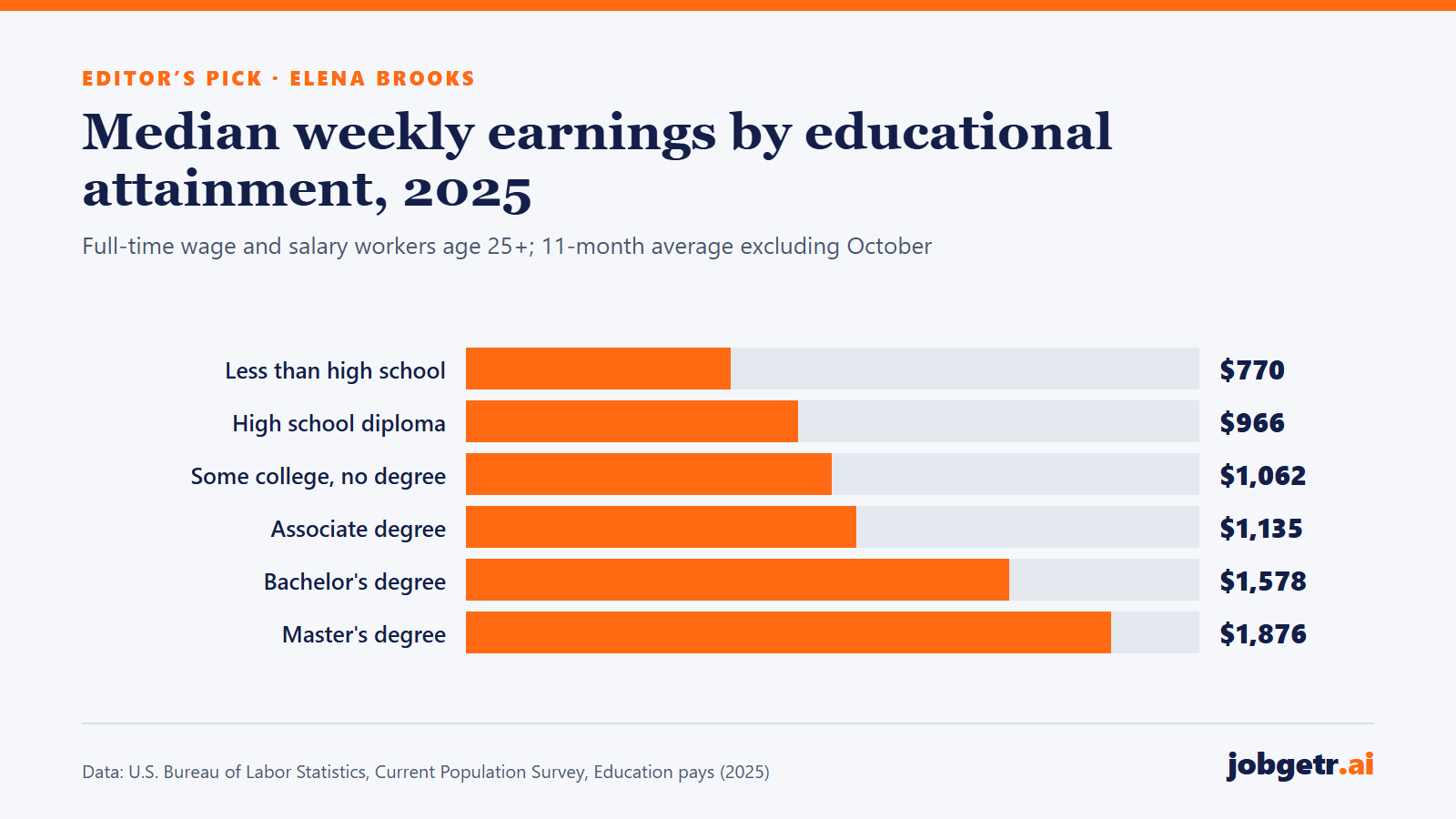
The unemployment gap points the same way. The unemployment rate for bachelor’s degree holders was 2.8% in 2025, against 4.3% for high school graduates and 6.1% for workers without a diploma. Associate degree holders ($1,135 a week, 3.0% unemployment) and workers with some college but no degree ($1,062, 3.8%) sit in between. The figures for all workers age 25 and over were $1,268 and 3.4%.
Two caveats matter. BLS notes that the 2025 annual estimates are 11-month averages that exclude October because of the federal government shutdown, so they are not directly comparable with other years. We therefore do not use this table to claim that the degree premium is rising or falling. BLS also notes that the categories reflect only the highest level of educational attainment and do not account for apprenticeships or other on-the-job training.
These are medians across very different occupations and people, not estimates of what a degree causes anyone to earn. But nothing in the latest federal data suggests the degree has stopped paying.
Credentials outside the degree
The degree is not the only credential associated with higher pay. A Census Bureau analysis published September 22 used 2019–2024 Survey of Income and Program Participation data to examine nondegree credentials: professional certifications, licenses and certificates. About 37% of adults ages 25 to 64 with at least a high school diploma had earned one. Full-time workers in that age group with a nondegree credential reported 16.4% higher median annual earnings than those without.
The association was strongest at the lower end of formal schooling. Workers whose education stopped at high school earned 7.4% more with a certificate or with a certification or license, and about 21.0% more with a combination of both. Census found no difference in median income between high school graduates holding a certification or license and workers with some college or an associate degree but no such credential. Among bachelor’s degree holders, only a certification or license on its own was associated with higher earnings, about 5% more.
Census is explicit that it “can’t definitively credit” these credentials for the higher earnings, because the survey does not ask when they were earned or whether they are relevant to the respondent’s current job. This is an association, not proof that a certificate raises pay.
How federal hiring rules are changing
Employer credential policy is harder to measure. We found no primary national data source tracking how many private employers have dropped degree requirements or whether their hiring changed. The federal civil service is the clearest documented case.
- Executive Order 13932, signed June 26, 2020, says an agency may set a minimum educational requirement for competitive-service jobs “only when a minimum educational qualification is legally required to perform the duties of the position.”
- The Chance to Compete Act of 2024 (Public Law 118-188, December 23, 2024) directs examining agencies to give preference to technical assessments of job-related skills for three years after enactment and, after that, to use them to examine applicants, subject to waivers. It also requires OPM to review whether evidence justifies education requirements for scientific, technical and professional positions.
- OPM’s Merit Hiring Plan, issued May 29, 2025, told agencies to eliminate requirements that are not relevant, such as degree requirements, and to phase out self-assessment questionnaires for ranking candidates. It strongly encouraged USA Hire assessments, which it said cover 135 job series and 65% of positions posted on USAJOBS.
- On April 13, 2026, OPM issued a competency-based qualification standard for the IT Management series (2210) that replaces the two earlier standards. OPM says education requirements are no longer a minimum qualification for the series; applicants must demonstrate required competencies, and education “may not be required” in place of demonstrating them.
This is policy, not an outcome measure. It does not yet show who gets hired, how those hires perform or how their pay compares.
Why the first rung matters
The question of how workers first prove they can do a job is getting sharper. Stanford Digital Economy Lab researchers reported in August that employment of workers ages 22 to 25 in highly AI-exposed occupations was about 19% below expected relative to less-exposed peers, with the adjustment coming primarily through reduced hiring of young workers. The authors call these descriptive patterns, not causal estimates, and note that the gaps shrink when they control for education. The study does not measure degree requirements, but it suggests the entry point is where adjustment is showing up first.
What this means for employers and workers
For employers, the federal approach offers a template: identify the roles that carry legal or licensing requirements, and for the rest, write down the competencies and test them. Removing a degree line from a posting without a validated assessment to replace it simply moves the screen somewhere less visible.
For workers, the data argue against treating the degree as either obsolete or sufficient. On average it still pays. Certifications and licenses are associated with higher earnings, most clearly for workers without a four-year degree. And a growing set of federal jobs is meant to be won on tested skills.
What to watch next: OPM’s review of education requirements under the Chance to Compete Act; the move to technical assessments that the law requires by December 2027; and whether future BLS and Census data can separate the value of a credential from the characteristics of the people who earn it.
Sources
- U.S. Bureau of Labor Statistics, “Education pays: Unemployment rates and earnings by educational attainment, 2025 (Table 5.1),” last modified September 1, 2026. https://www.bls.gov/emp/tables/unemployment-earnings-education.htm
- U.S. Census Bureau, “Beyond Diplomas: Nondegree Credentials Linked to Higher Earnings,” September 22, 2026. https://www.census.gov/library/stories/2026/09/nondegree-credentials.html
- Federal Register (via GovInfo), “Executive Order 13932, Modernizing and Reforming the Assessment and Hiring of Federal Job Candidates,” signed June 26, 2020. https://www.govinfo.gov/content/pkg/FR-2020-07-01/html/2020-14337.htm
- U.S. Congress (via GovInfo), “Chance to Compete Act of 2024, Public Law 118-188,” December 23, 2024. https://www.govinfo.gov/content/pkg/PLAW-118publ188/html/PLAW-118publ188.htm
- U.S. Office of Personnel Management, “Merit Hiring Plan,” May 29, 2025. https://www.opm.gov/chcoc/latest-memos/merit-hiring-plan.pdf
- U.S. Office of Personnel Management, “Competency-Based Qualification Standards for the Information Technology Management Series, 2210 (memorandum),” April 13, 2026. https://www.opm.gov/chcoc/latest-memos/competency-based-qualification-standards-for-the-information-technology-management-series-2210.pdf
- U.S. Office of Personnel Management, “Competency-Based Qualification Standard for the Information Technology Management Series, 2210,” accessed September 24, 2026. https://www.opm.gov/policy-data-oversight/classification-qualifications/competency-based-policy/general-schedule/2200/2210-competency-based-policy/competency-based-qualification-standard/
- Stanford Digital Economy Lab, “No Widespread Displacement, but the AI Employment Gap for Young Workers Has Widened to 19%,” August 12, 2026. https://digitaleconomy.stanford.edu/news/canariesaug26/
Featured photo: Graduates at the 2018 UC Davis College of Engineering commencement. Photo: UC Davis College of Engineering, via Wikimedia Commons (CC BY 2.0). Resized from the original.




.jpg)