



A common claim in workforce debates is that AI-era jobs, which mix technical tasks with judgment and communication, need a training system that is not ready for them. Stated that broadly, the claim is hard to test. The Labor Department’s Registered Apprenticeship data allow a narrower and more useful set of questions: Is the country’s main structured earn-and-learn system growing? Where is it concentrated? And how many people who start actually finish?
Capacity has grown steadily
DOL’s Apprentices by State dashboard, with data through September 3, 2026, reports 727,586 active apprentices nationally. Its fiscal-year series shows 389,653 in FY2016, 555,596 in FY2020, 659,484 in FY2024 and 695,381 in FY2025. The current FY2026 count is 78.46% above FY2016. Year-over-year growth was positive in every year from FY2017 through FY2025, ranging from 1.46% in FY2021 to 12.47% in FY2018.
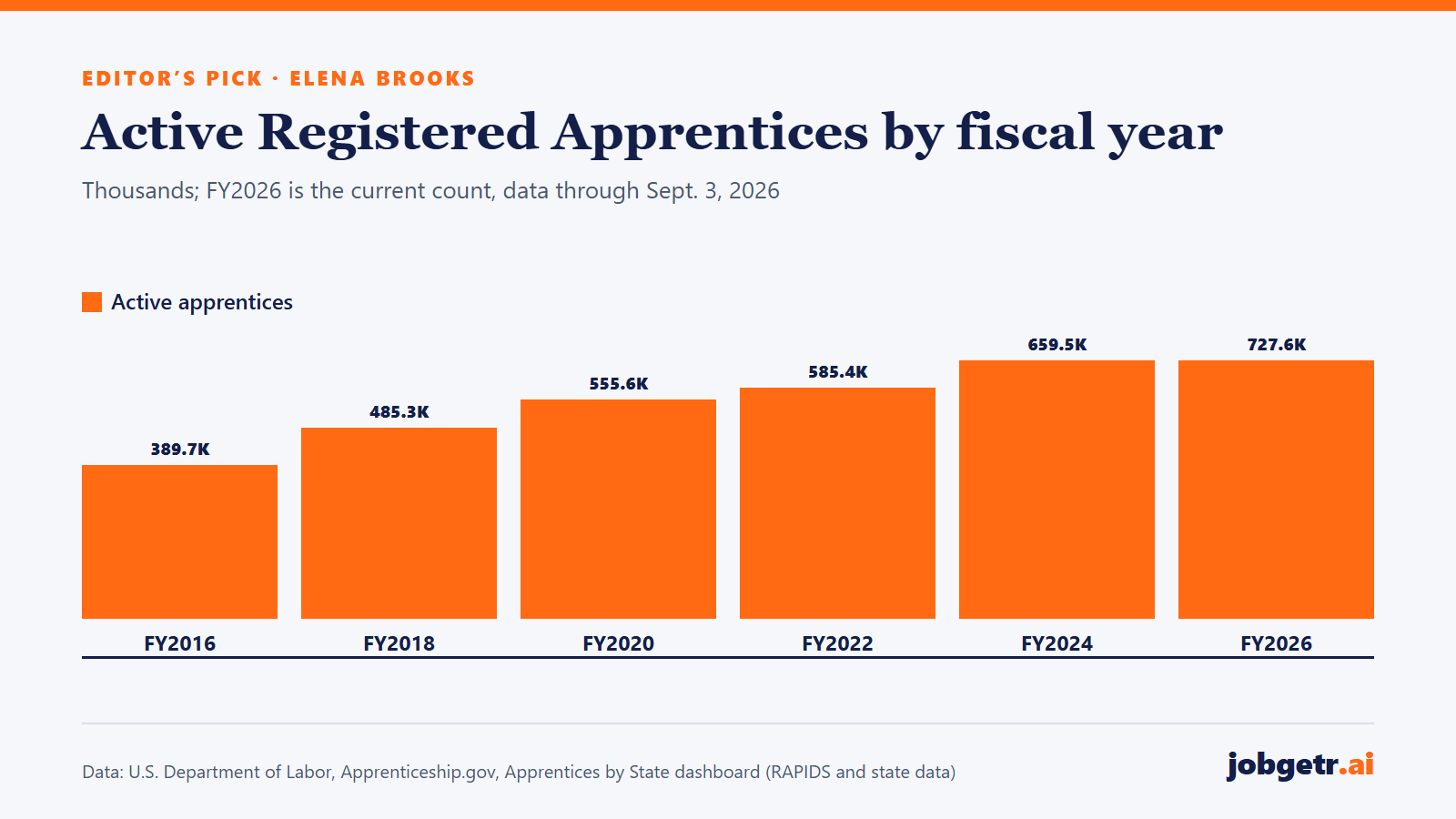
Coverage caveats apply. Connecticut, Maryland and New York do not use DOL’s RAPIDS system and report their data separately, and data for programs with fewer than 10 apprentices are suppressed to protect privacy.
It is concentrated in a few industries
The same dashboard breaks down FY2026 active apprentices by industry. Construction accounts for 290,043, or 39.86%. Public administration accounts for 148,707 (20.44%), educational services 88,417 (12.15%) and manufacturing 31,131 (4.28%). Health care and social assistance has 15,939 (2.19%), and professional, scientific and technical services 5,669 (0.78%). Another 81,478 (11.20%) have no industry recorded.
The Information sector, which had the highest AI-use rate in the Census Bureau’s Business Trends and Outlook Survey (39.7% of businesses as of May 3), does not appear among the ten largest industry categories on the dashboard. Neither does Finance and Insurance, the second-highest at 33.9%.
That does not mean apprenticeship cannot serve those fields. It shows where the system’s capacity sits today: largely in the building trades and the public sector, not in the knowledge-intensive industries where business AI use is highest.
Completion is the harder number
Enrollment is one measure; completion is another. Federal regulation defines the completion rate as the share of an apprenticeship cohort that receives a certificate of completion within one year of the projected completion date, excluding apprentices cancelled during the probationary period. In a March 9 circular, DOL’s Office of Apprenticeship explained that because of that extra year, rates are published with a lag: data released at the end of FY2025 reflect the FY2024 cohort.
DOL’s Completion Rate Analysis dashboard reports a nationwide completion rate of 46.49% for FY2024, with a count of 92,174. Fewer than half of the apprentices in that measured cohort finished within a year of their scheduled end date.
Rates differ widely by industry. For FY2024 the dashboard shows 44.61% in construction, 50.22% in professional, scientific and technical services, 50.25% in health care and social assistance, 55.07% in information, 62.48% in manufacturing, 65.53% in finance and insurance and 66.11% in utilities.
A completion rate is not a failure rate. The measure does not record why people leave, and some who exit may do so for jobs. But it is the clearest national evidence available that getting people into a program and getting them through it are different problems.
Why this matters for entry-level workers
Pressure on first jobs gives the issue urgency. Stanford Digital Economy Lab researchers reported in August that employment of workers ages 22 to 25 in highly AI-exposed occupations was about 19% below expected relative to less-exposed peers, primarily through reduced hiring rather than increased separations; experienced workers showed no comparable gap. A September Stanford working paper covering 41 countries found the junior share of the workforce fell at foreign affiliates of AI-adopting firms, driven mainly by growth in senior employment. Both are observational, and neither evaluates apprenticeships or community colleges. Together they describe a plausible problem: if employers lean toward experienced hires, structured routes to experience become more valuable.
Federal policy is moving in that direction. On April 1, DOL announced a national contracting opportunity to integrate AI skills into Registered Apprenticeship, including embedding AI training in existing programs and strengthening pipelines in areas such as data centers, telecommunications and advanced manufacturing. On April 29, it launched an AI in Registered Apprenticeship Innovation Portal. These are initiatives, not yet results.
What is still missing
The evidence supports a narrower conclusion than the working headline, “the training system isn’t ready.” The apprenticeship system is growing; it is concentrated outside the most AI-intensive industries; and fewer than half of a recent cohort completed under the regulatory definition. What we could not find in national primary data is the piece that matters most to workers: job placement and earnings after completion across all programs, and a measure of employers’ unmet demand for apprentices in roles that mix technical and nontechnical skills. DOL’s grants performance dashboard reports employment and earnings outcomes for participants in specific grant programs, which is not the whole system.
For employers, the implication is to track completion and retention, not just starts. For workers, DOL’s dashboard lets anyone check completion rates by state and industry before enrolling. What to watch next: the FY2025 completion data, the first outputs of DOL’s AI apprenticeship contract and whether outcome reporting extends beyond grant-funded programs.
Sources
- U.S. Department of Labor, Apprenticeship.gov, “Apprentices by State Dashboard (data through September 3, 2026),” accessed September 24, 2026. https://www.apprenticeship.gov/data-and-statistics/apprentices-by-state-dashboard
- U.S. Department of Labor, Apprenticeship.gov, “Apprentice Completion Rate Analysis (BETA),” accessed September 24, 2026. https://www.apprenticeship.gov/data-and-statistics/completion-rate-analysis
- U.S. Department of Labor, Office of Apprenticeship, “Office of Apprenticeship Circular No. 2026-03: Registered Apprenticeship Program Completion Rates,” March 9, 2026. https://www.apprenticeship.gov/sites/default/files/bulletins/2026-03%20Registered%20Apprenticeship%20Program%20Completion%20Rates.pdf
- U.S. Department of Labor, Apprenticeship.gov, “Apprenticeship Grants Performance Dashboard,” accessed September 24, 2026. https://www.apprenticeship.gov/data-and-statistics/apprenticeship-grants-performance-dashboard
- U.S. Census Bureau, “Large Firms With at Least 20 Employees Biggest AI Users,” May 26, 2026. https://www.census.gov/library/stories/2026/05/ai-use-businesses.html
- Stanford Digital Economy Lab, “No Widespread Displacement, but the AI Employment Gap for Young Workers Has Widened to 19%,” August 12, 2026. https://digitaleconomy.stanford.edu/news/canariesaug26/
- Stanford Digital Economy Lab, “How Does AI Change Labor Demand? Evidence from 41 Countries (working paper),” September 21, 2026. https://digitaleconomy.stanford.edu/publication/how-does-ai-change-labor-demand/
- U.S. Department of Labor, “US Department of Labor launches landmark initiative to integrate artificial intelligence skills into Registered Apprenticeships nationwide,” April 1, 2026. https://www.dol.gov/newsroom/releases/eta/eta20260401
- U.S. Department of Labor, “US Department of Labor launches website to build artificial intelligence skills, expand AI-focused Registered Apprenticeship programs,” April 29, 2026. https://www.dol.gov/newsroom/releases/eta/eta20260429
Featured photo: Jory Robertson, a carpenter apprentice with Pacificmark Construction NW, photographed by the Oregon Department of Transportation. Representative image. Photo: Oregon Department of Transportation, via Wikimedia Commons (CC BY 2.0).





.jpg)