

A familiar argument in recruiting holds that employers no longer struggle to find candidates; they struggle to sort them. It is an intuitive claim in an era of one-click applications and AI-assisted résumés. But it is a hypothesis, not a finding, and the national data most often cited in hiring debates cannot confirm it. What those data can do is show why employers need to measure their own hiring funnels before deciding where the bottleneck is.
What the national numbers show
The Bureau of Labor Statistics’ Job Openings and Labor Turnover Survey (JOLTS) reported 7.3 million job openings on the last business day of July 2026, an openings rate of 4.4%. During the same month, employers made 5.1 million hires, a hires rate of 3.2%. Both figures were little changed from June.
These two numbers measure different things. Openings are a stock: positions open on a single day at month’s end. Hires are a flow: every addition to payrolls over the entire month. Dividing one by the other does not produce a “fill rate.” A position posted early in July and filled two weeks later appears in July hires but not in July’s month-end openings. A hard-to-fill role that has been open since spring can appear in openings every month and in hires in none.
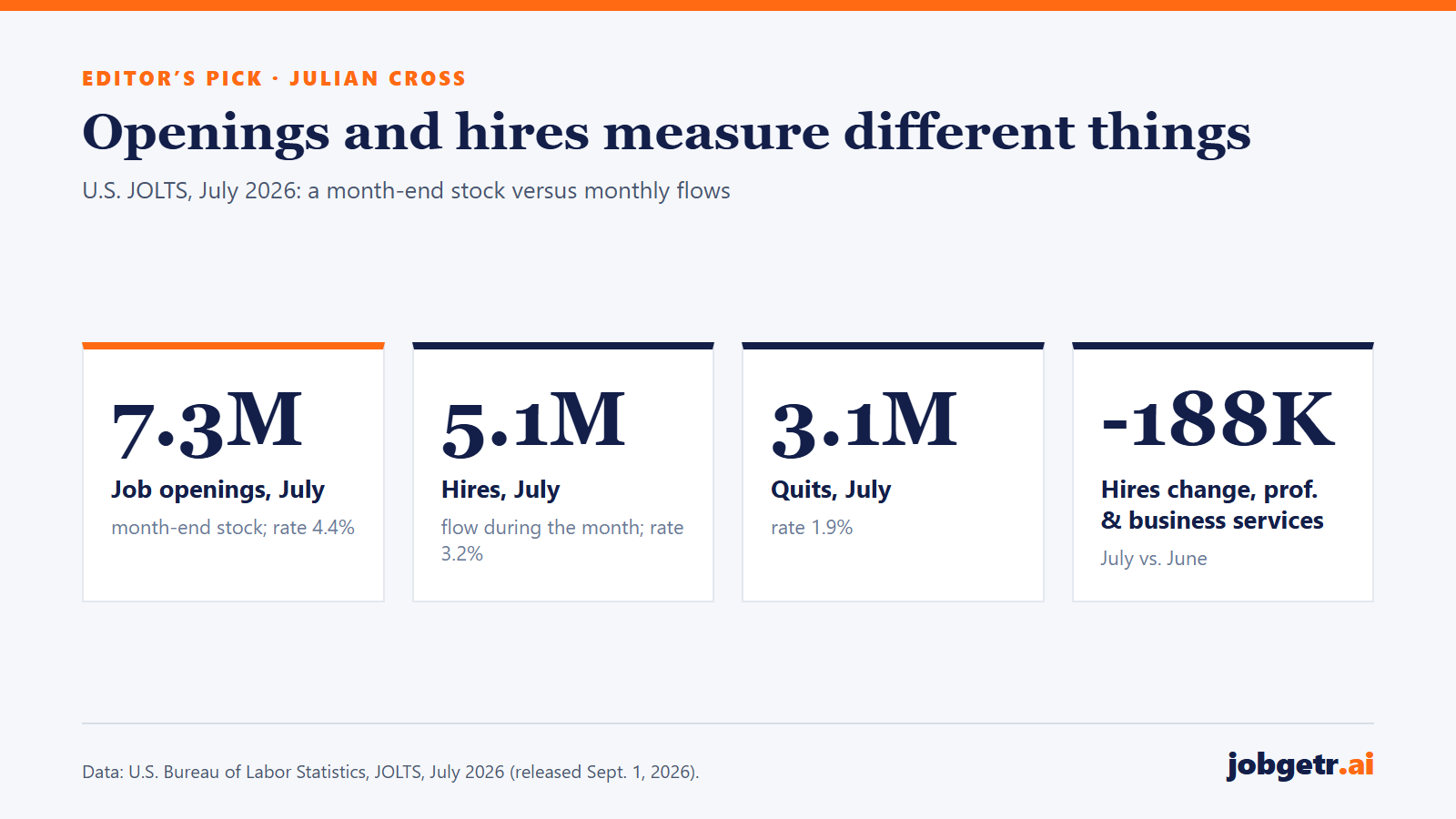
Other July flows help frame the picture. Quits were 3.1 million (a rate of 1.9%), layoffs and discharges were 1.7 million (1.0%), and total separations were 5.1 million, about the same as hires. By industry, hires fell by 188,000 in professional and business services, while openings rose by 76,000 in durable goods manufacturing.
Openings well above monthly hires, subdued quits and low layoffs describe a market in which employers are holding on to workers and adding cautiously. That pattern is consistent with several different recruiting stories: slow screening, thin candidate pools, cautious budget approvals, or openings that employers are in no hurry to fill. The aggregate numbers do not choose among them.
What the data cannot tell us
JOLTS does not count applications, screens, interviews or offers. It cannot tell whether an employer received too many applicants or too few qualified ones, and it cannot tell whether an opening stayed open because a hiring manager was still reviewing candidates or because nobody suitable applied. National totals also blend very different labor markets. A hospital seeking licensed nurses and a firm fielding a large volume of applications for a junior office role both contribute to the same openings count.
So the thesis that hiring “is becoming a screening problem, not a sourcing problem” cannot be tested with public national data. It may hold for some occupations and employers and fail for others, particularly roles with licensing requirements or small candidate pools. We did not find a representative primary data source that measures the balance between sourcing difficulty and screening difficulty across the U.S. economy, and we are not presenting one here. That is why this piece asks the question rather than answering it.
Where the bottleneck can be measured
The place to answer the question is inside an employer’s own hiring process. A funnel has countable stages, and each one can reveal a different kind of problem:
- Reach: how many people saw the posting, and through which channels.
- Application completion: the share of people who start an application and finish it. Long forms and mandatory account creation can lose candidates before anyone reviews them.
- Screen pass-through: the share of applicants passing each automated or human screen, and whether the criteria used are stated in the job description.
- Interview-to-offer and offer acceptance: where candidates drop out after the employer has already invested time in them.
- Time in stage: days spent at each step, including internal approvals that candidates never see.
- Quality of hire: performance and retention at six or twelve months, linked back to how each hire fared at each screen.
These stages point to different diagnoses. If an employer has plenty of qualified applicants but screens out many people who would have succeeded, that is a screening problem. If few qualified people apply at all, that is a sourcing problem. If candidates pass every screen and then decline offers, the constraint may be pay, schedule, location or the pace of the process. Each diagnosis implies a different fix.
The last measure matters most and is most often skipped. A screen is useful only if it predicts success in the job. Keyword filters, knockout questions and AI-assisted scoring should be tested against later outcomes rather than assumed to work because they reduce volume. Shrinking a pile of applications is not the same as selecting the right people from it, and nothing in the public data establishes that automated scoring is inherently better at that task than a well-designed human review.
Implications for employers and workers
For employers, the practical step is to instrument the funnel before buying a remedy. A tool that speeds screening will not help if the real constraint is a shortage of qualified applicants, and a sourcing campaign will not help if good candidates are filtered out at the second step. Several low-cost checks are available now: whether job descriptions state the actual requirements, whether reviewers use consistent work-sample criteria, whether the application works on a phone and with assistive technology, and how long each stage takes.
For job seekers, the national figures say little about individual odds. Millions of openings do not mean millions of accessible jobs for a particular person in a particular place, and a hiring decline in one sector, such as professional and business services in July, can matter more to someone in that field than the headline total. Candidates can reasonably ask how applications are reviewed, what the steps are and how long the process usually takes.
The next JOLTS release, covering August, is scheduled for September 29, 2026. Two things are worth watching: whether monthly hires move closer to or further from month-end openings, and whether the July drop in professional and business services hiring persists. jobgetr.ai will continue to treat openings and hires as separate signals rather than as a single measure of hiring difficulty.
Sources
- U.S. Bureau of Labor Statistics, “Job Openings and Labor Turnover Summary, July 2026,” 2026-09-01. https://www.bls.gov/news.release/jolts.nr0.htm
Featured photo: Company interviews during an employer matchmaking session at Tech Elevator. Photo: Andriatriv, via Wikimedia Commons (CC BY-SA 4.0). Resized from the original.