
AI tools are moving into the interview stage of hiring. Software can now schedule conversations, draft structured question sets, transcribe answers, summarize what a candidate said and, in some products, score responses. That raises a practical question for recruiting teams: if software handles more of the interview, what is the recruiter for?
The working version of this piece began from a stronger premise, that AI can interview better than people. The sources reviewed for this article do not establish that, and we do not assume it here. The more useful question is how the work of recruiting is being redistributed, and who remains accountable for the decision at the end.
What “better” would have to mean
An interview is a measurement tool. Calling one method better than another requires evidence of a specific kind: a defined job; an outcome benchmark such as later job performance or retention; a comparison against a structured human process on comparable candidates; results that hold across demographic groups and for candidates who need accommodations; and known error rates for transcription and scoring. Labor-market statistics do not supply that evidence, and a vendor’s description of its own product is not an independent test.
Without that evidence, “better” usually means faster, cheaper or more consistent. Those can be real gains. A standardized question set asked the same way to every candidate is easier to compare than a series of unstructured chats. But speed and consistency are not the same as accuracy. A polished transcript and a tidy summary can make a weak selection process look rigorous.
What the labor-market evidence does say
The broader research on AI and employment is relevant, though not about recruiters specifically. In an August 12 update using ADP payroll data, Stanford Digital Economy Lab researchers Erik Brynjolfsson, Bharat Chandar and Ruyu Chen reported that they “do not see widespread, economy-wide job displacement associated with AI.” They did find that employment of workers ages 22 to 25 in highly AI-exposed occupations was about 19% below what would be expected relative to less-exposed peers, a gap that had widened from 15% in July 2025.
Two details matter for hiring teams. First, the researchers found the adjustment operating “primarily through reduced hiring of young workers rather than increased separations.” Experienced workers showed no comparable gap. Second, declines were concentrated in occupations where AI use tends to automate tasks; where AI complements workers, employment was flat or rising. So far, they wrote, adjustment is “showing up primarily in employment rather than base pay.”
The authors are careful about limits. Their results are “descriptive patterns, not causal estimates.” The gaps shrink when education is controlled for, some trends predate generative AI, and the estimates are larger in the ADP sample than in national survey benchmarks.
Read with those limits, the study does not say recruiters are being displaced. It says the early-career hiring decision is one of the places where change is appearing. That puts recruiters at the point where any adjustment is actually carried out. The automate-versus-complement distinction is also a useful lens for recruiting work itself, as analysis rather than a research finding: scheduling and transcription look like tasks software can take over, while judgment, negotiation and relationship work look more like tasks it can support.
Where accountability sits
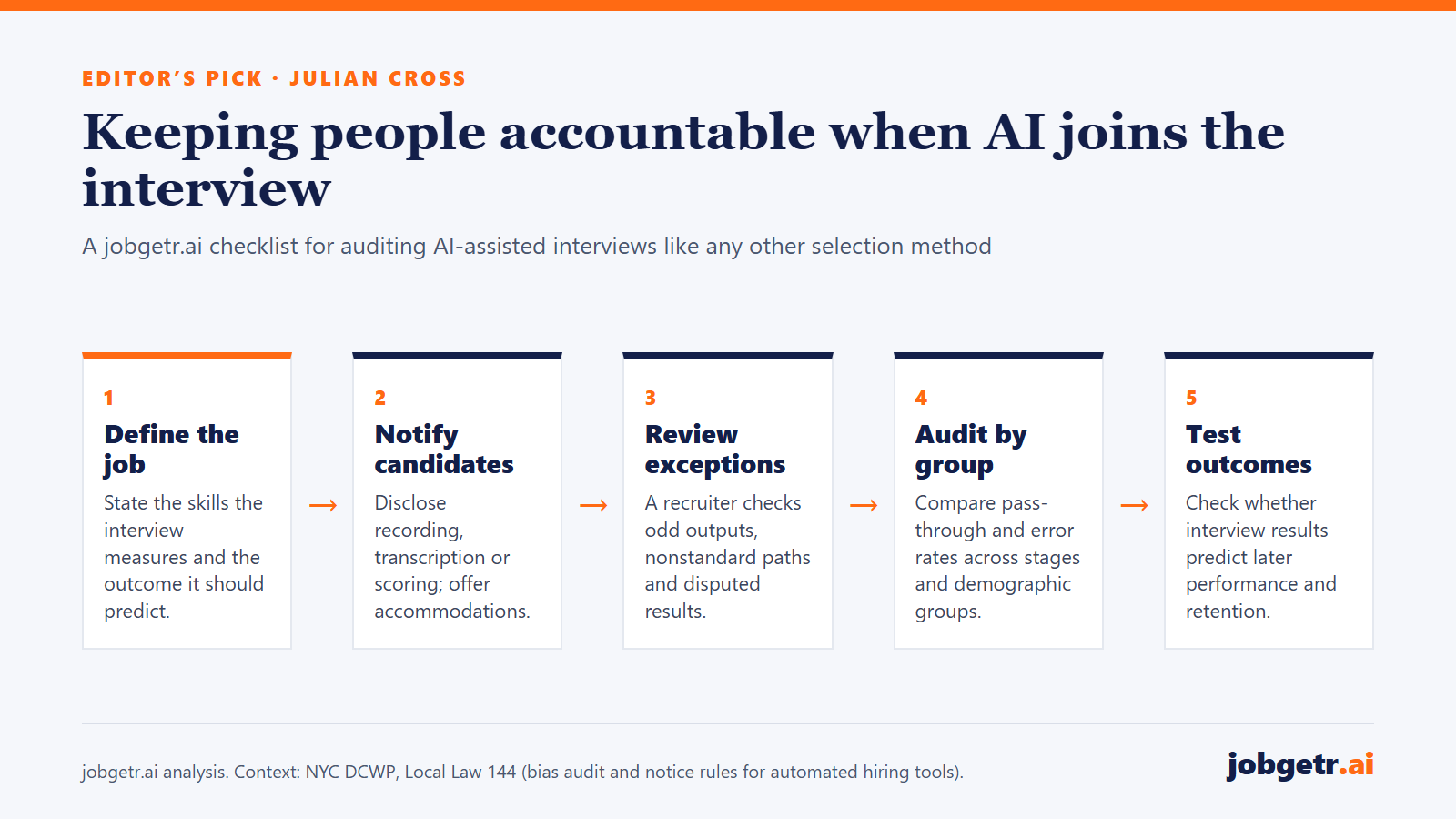
Some jurisdictions have already put rules around automated hiring tools. New York City’s Local Law 144 of 2021, enforced by the city’s Department of Consumer and Worker Protection since July 5, 2023, prohibits employers and employment agencies from using an automated employment decision tool unless it has had a bias audit within one year of use. Information about the audit must be made publicly available, and employers must give candidates or employees certain notices.
Whatever the local rules, someone inside the employer has to own the outcome. That is where a recruiter’s role can grow rather than shrink:
- Candidate relationships: explaining the process, answering questions and keeping strong candidates engaged.
- Exception review: handling nonstandard career paths, accommodation requests and cases where a tool’s output looks wrong.
- Compensation and offer negotiation: work that depends on context a transcript does not capture.
- Tool oversight: checking whether automated steps are working as intended and escalating when they are not.
- Accountability: being able to explain, to a candidate or a regulator, why a decision was made.
What employers should measure
Employers deploying AI in interviews should audit it the way they would audit any selection method. That means documenting candidate notice and consent; confirming that the process works with assistive technology and that accommodations are available; tracking transcription and scoring errors, including how often a human reviewer disagrees with the tool; comparing pass-through rates by stage and by group; watching whether candidates abandon the process at AI-driven steps; and, over time, testing whether interview results predict job performance and retention.
For job seekers, it is reasonable to ask whether an interview will be recorded, transcribed or scored by software, who reviews the results, and how to request an accommodation. In New York City, the notice requirement means employers covered by the law must tell candidates about the tool.
The next Stanford Digital Economy Lab updates, and the September 21 working paper from Chandar and Bouke Klein Teeselink on AI and labor demand across 41 countries, will add evidence on how employers reshape junior and senior hiring. None of it yet answers whether AI interviews better. Until independent, outcome-based evidence exists, the defensible position is that AI can take on parts of the interview while people remain responsible for the decision.
Sources
- Stanford Digital Economy Lab, “No Widespread Displacement, but the AI Employment Gap for Young Workers Has Widened to 19% (Erik Brynjolfsson, Bharat Chandar, Ruyu Chen),” 2026-08-12. https://digitaleconomy.stanford.edu/news/canariesaug26/
- NYC Department of Consumer and Worker Protection, “Automated Employment Decision Tools (AEDT),” accessed 2026-09-24. https://www.nyc.gov/site/dca/about/automated-employment-decision-tools.page
- Stanford Digital Economy Lab, “How Does AI Change Labor Demand? Evidence from 41 Countries (working paper; Bharat Chandar, Bouke Klein Teeselink),” 2026-09-21. https://digitaleconomy.stanford.edu/publication/how-does-ai-change-labor-demand/
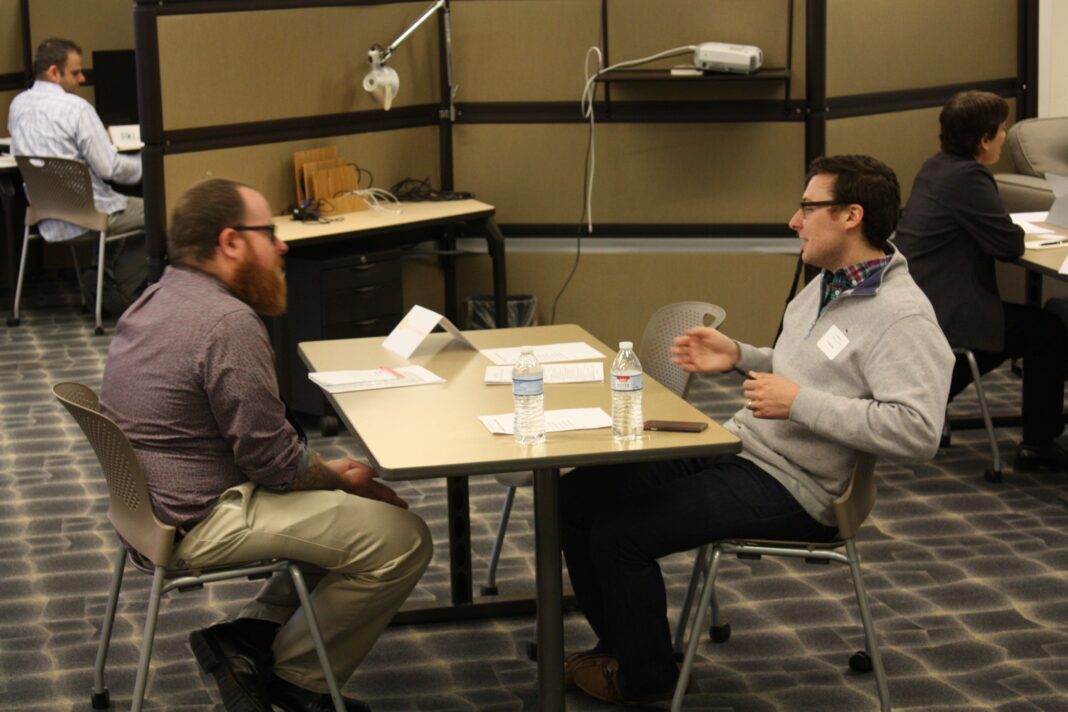
Featured photo: A job interview. Representative image; not the people or employers discussed in this article. Photo: amtec_photos, via Wikimedia Commons (CC BY-SA 2.0). Resized from the original. Photo courtesy of amtec.