


Employers
President Donald Trump signed an executive order on Monday, Oct. 19, directing the National Institutes of Health to create a Women’s Health Division within 90 days and establishing a White House Women’s Health Task Force. The order sets out research priorities in detail, but it names no budget figure, no staffing level and no new appropriation; implementation is “subject to the availability of appropriations.”
The order, titled “Advancing Women’s Health to Improve Outcomes in All Phases of Life,” tells the Secretary of Health and Human Services, acting through the NIH director, to “establish a Women’s Health Division within an appropriate institute or center within 90 days.” The division is to work with the existing NIH Office of Research on Women’s Health, which Reuters reported was founded in 1990, rather than replace it.
What the division is told to do
The order assigns the division seven areas of work with the research office: reviewing understudied conditions, coordinating research including replication studies, advancing diagnostic and care technologies, interdisciplinary collaboration, sex-specific data and the inclusion of women in clinical trials, holding grantees accountable for considering sex as a biological variable, and translating discoveries into practice. Conditions named in the order include cardiovascular disease, cancer, stroke, Alzheimer’s disease, autoimmune and inflammatory conditions, osteoporosis, mental health, chronic pain, endometriosis, fibroids, infertility, maternal health and menopause.
The one passage that touches the research workforce directly asks the division to work with federal partners on “policy leadership on, career development in, and advancement of women’s health research across disciplines.” The order does not define what that career-development work will involve.
The task force
The task force is co-chaired by the HHS secretary and the White House chief of staff. Reuters identified them as Robert F. Kennedy Jr. and Susie Wiles and reported that the group was to hold its first meeting Monday. Its members include the secretaries of Labor, Agriculture, Education, Veterans Affairs and War, the EPA administrator, and the heads of the FDA, CDC, NIH, ARPA-H and the Centers for Medicare & Medicaid Services. HHS is to fund the task force’s administrative costs. Its assigned functions include translating research into practice and “updated clinical education based on the best available science,” and supporting a “robust supply chain of providers and medical products.” The order sets no deadline or reporting requirement for the task force and no end date.
The order revokes President Joe Biden’s Executive Order 14120 of March 18, 2024, on women’s health research, and a Nov. 13, 2023, presidential memorandum that created a White House initiative on the issue. Trump credited first lady Melania Trump with conceiving the effort, Reuters reported. She said it should “ensure that medical breakthroughs are accessible and affordable to women, regardless of their financial circumstances.”
The employment backdrop
For research employers and job seekers, the order is a reorganization and a set of priorities, not a hiring announcement. It does not say how many people the new division will employ or whether its staff will be new hires or reassigned from existing NIH institutes. Reuters noted that the administration has pushed health care cuts, including at NIH, and moved last year to shrink the federal health care workforce.
Federal payrolls overall have shrunk over the past year. Bureau of Labor Statistics data show federal employment excluding the Postal Service at 2,083,300 in September 2026 (preliminary), down from 2,321,500 in September 2025, a decline of 238,200; the largest monthly drop over that span came in October 2025, when the count fell to 2,156,800. These figures cover all federal agencies, not NIH alone.
In the private sector, where much grant-funded and contract research takes place, employment in scientific research and development services was 918,300 in September 2026 (preliminary), compared with 912,200 a year earlier, BLS data show.
The parts of the order to watch are NIH’s choice of a host institute for the division, any budget request tied to it, and funding announcements or job postings that follow. None of those had been released as of Monday.
Sources
- The White House, “Advancing Women’s Health to Improve Outcomes in All Phases of Life,” October 19, 2026. https://www.whitehouse.gov/presidential-actions/2026/10/advancing-womens-health-to-improve-outcomes-in-all-phases-of-life/
- GV Wire (Reuters), “Trump Signs Order Creating NIH Division, Task Force for Women’s Health,” October 19, 2026. https://gvwire.com/2026/10/19/trump-signs-order-creating-nih-division-task-force-for-womens-health/
- U.S. Bureau of Labor Statistics, “All employees, thousands, scientific research and development services, seasonally adjusted,” accessed October 19, 2026. https://data.bls.gov/timeseries/CES6054170001
- U.S. Bureau of Labor Statistics, “All employees, thousands, federal, except U.S. Postal Service, seasonally adjusted,” accessed October 19, 2026. https://data.bls.gov/timeseries/CES9091100001
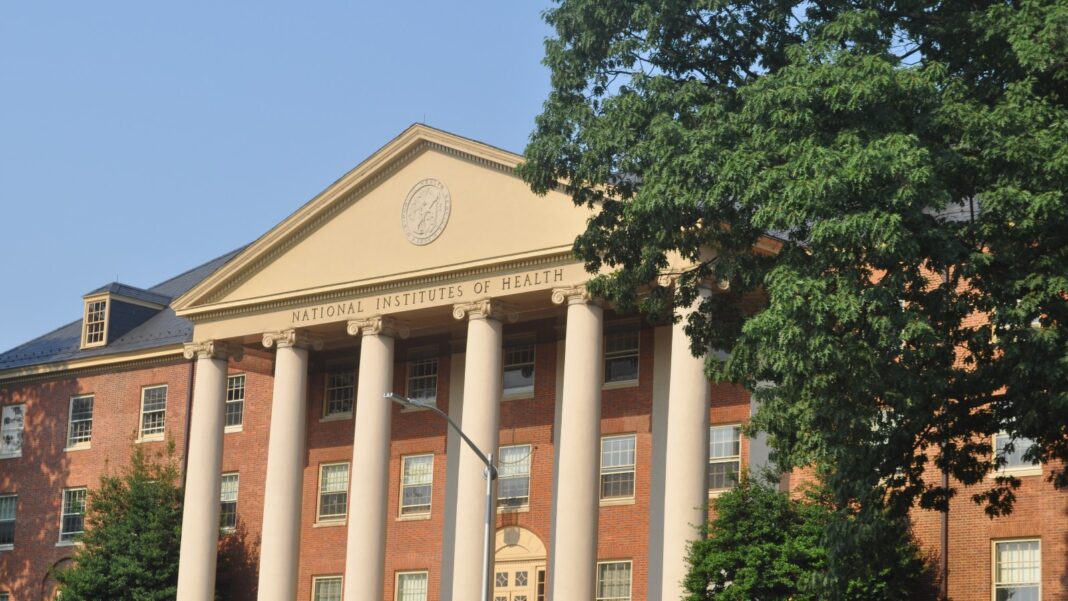
Featured photo: The James H. Shannon Building (Building One) on the National Institutes of Health campus in Bethesda, Md., July 1, 2015. Photo: Lydia Polimeni, National Institutes of Health, via Wikimedia Commons (Public domain). Cropped from the original.