
Wages
Consumer prices rose faster than paychecks in September. Prices climbed 0.6% from August while average hourly pay rose 0.1%, so the purchasing power of an hour of work fell 0.5%, the Bureau of Labor Statistics reported Oct. 14 in its Consumer Price Index and Real Earnings releases for September.
The Consumer Price Index for All Urban Consumers rose a seasonally adjusted 0.6% in September, after a 0.4% increase in August. Over the 12 months through September, prices were up 3.7%, compared with a 3.4% annual rate in August. Excluding food and energy, the core index rose 0.3% for the month and 2.6% over the year.
Gasoline did most of the damage
Fuel was the main driver. The gasoline index jumped 9.1% in September and, according to BLS, accounted for more than half of the monthly all-items increase. Gasoline prices were 34.2% higher than a year earlier, and the broader energy index rose 5.2% in the month and 20.4% over the year.
Most other household costs moved far less. Shelter rose 0.4% in September and 3.2% over the year, with rent of primary residence up 0.2% for the month. The food index was unchanged, and food at home slipped 0.1%, leaving grocery prices 1.8% above a year earlier. Food away from home rose 0.2%. Airline fares rose 1.2% in the month and 22.4% over the year. Medical care rose 0.1%, and motor vehicle insurance was 5.0% lower than a year earlier.
What happened to paychecks
For all private-sector employees, average hourly earnings rose 5 cents, or 0.1%, to $37.81 in September. After adjusting for prices, real average hourly earnings fell 0.5%, from $11.30 to $11.24 in 1982-84 dollars, the constant-dollar measure BLS uses for the series.
The average workweek held at 34.4 hours, so weekly pay did not make up the gap. Average weekly earnings rose 0.1% to $1,300.66, and real average weekly earnings also fell 0.5%.
Over the year, the picture is weaker for each hour worked than for each week. Nominal hourly earnings were up 3.0% from September 2025, short of the 3.7% rise in prices, leaving real average hourly earnings 0.7% lower. Real weekly earnings were down only 0.1% over the year, because the average workweek was 0.6% longer than a year earlier: workers are getting slightly more inflation-adjusted pay per week partly by working more hours.
Production and nonsupervisory employees fared slightly worse in September. BLS adjusts their pay with a different index, the CPI for Urban Wage Earners and Clerical Workers, which rose 0.7% in the month and 3.9% over the year, more than the overall CPI. Their average hourly earnings rose 0.2% to $32.60, so real hourly earnings fell 0.6% for the month and 0.6% over the year. Their real weekly earnings fell 0.5% in September and were 0.3% lower than a year earlier.
What it means for workers and employers
The September gap between prices and pay is wider than August’s, when real hourly earnings slipped 0.1% after a 0.3% pay gain and a 0.4% price increase. Because more than half of the latest price jump came from gasoline, the hit falls hardest on workers with long commutes or jobs that require driving, and it could reverse quickly if fuel prices fall. Core inflation of 2.6% sits below the 3.0% annual pace of nominal pay growth, which suggests that, outside energy, wages are still running ahead of prices.
For employers setting raises, the release is a reminder that a 3% increase this year did not preserve the buying power of an hour of work. For workers comparing offers, a gain that looks solid in dollars can still lose ground after fuel and other costs.
Caveats
These are national averages. They do not measure any one household’s costs, and the Real Earnings report is national only, so it says nothing about pay in Atlanta or any other metro area. The August and September earnings figures are preliminary and subject to revision. BLS is scheduled to release October CPI and Real Earnings on Tuesday, Nov. 10.
Sources
- U.S. Bureau of Labor Statistics, “Real Earnings — September 2026,” October 14, 2026. https://www.bls.gov/news.release/archives/realer_10142026.htm
- U.S. Bureau of Labor Statistics, “Consumer Price Index — September 2026,” October 14, 2026. https://www.bls.gov/news.release/archives/cpi_10142026.htm
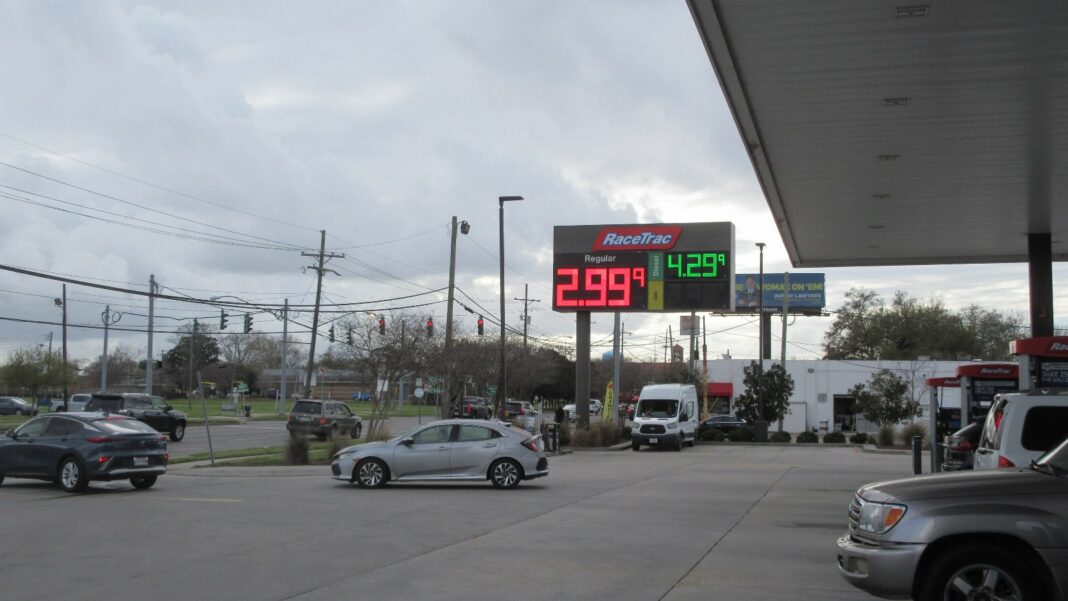
Featured photo: A RaceTrac gas station price sign in Jefferson Parish, Louisiana, March 5, 2026, as fuel prices began to climb. Representative image; not a source of the September price data. Photo: Infrogmation, via Wikimedia Commons (CC BY-SA 4.0). Cropped from the original.