


Job Market
U.S. employers reported about 7.08 million job openings on the last business day of August, down from a revised 7.34 million in July, according to the Job Openings and Labor Turnover Survey (JOLTS) released September 29 by the Bureau of Labor Statistics. Hiring and departures barely moved. The agency said hires “changed little” and total separations were unchanged, leaving a labor market in which employers are still advertising positions but relatively few people are moving into or between jobs.
What changed
The openings rate slipped to 4.3% from 4.4% in July. Hires totaled about 5.19 million, a hires rate of 3.3%. Total separations were about 5.07 million, made up of roughly 3.07 million quits, 1.64 million layoffs and discharges, and 363,000 other separations. The quits rate held at 1.9%, and the layoffs-and-discharges rate edged down to 1.0%.
Revisions also matter. July’s openings estimate was revised up by 64,000, to about 7.34 million from the roughly 7.27 million first published. July hires were revised up by 92,000 and separations by 56,000. JOLTS figures are sample-based estimates, and the latest month is routinely revised when the next report is published.
Openings versus hires
An opening is a position an employer is actively recruiting for on the last business day of the month. Hires count everyone added to payrolls over the whole month. The roughly 1.9 million difference between August openings and August hires is therefore not a count of unfilled jobs: the two measures cover different time frames, and a position can be posted and filled, or withdrawn, within the same month.
Indeed Hiring Lab offers one way to connect the two. In its September 29 analysis of the release, economist Cory Stahle compared hires in a month with openings at the end of the previous month, a ratio Indeed calls vacancy yield. August hires against July openings came to about 0.7 hires per opening, and the three-month moving average slipped to about 0.71. Indeed puts the comparable figure at about 0.8 in August 2019 and 0.5 at its 2022 low. “Employers keep signaling that they want more workers, but they just aren’t hiring them,” Stahle wrote. The ratio is Indeed’s derived measure, not a BLS statistic, and it does not show whether any particular posted job was filled.
Where the movement was
Quits fell in wholesale trade, down about 34,000, and in state and local government education, down about 21,000. They rose in nondurable goods manufacturing and private educational services. Those industry shifts are small relative to the national totals, and one month of industry detail is noisy.
Why it matters
Low layoffs protect many workers who already have jobs. Low quits and flat hiring, though, mean fewer openings created by people changing employers, which can make it harder for job seekers and career changers to land offers. For employers, a steady openings count alongside flat hiring suggests that recruiting demand has not collapsed but is not turning into faster payroll growth.
Limits and next checks
JOLTS is a national establishment survey. It is not a list of jobs available to any individual applicant, and its national figures should not be read as an estimate for metro Atlanta or any other local market. The September Employment Situation report, due October 2, will update payroll growth and unemployment from separate surveys. The September JOLTS report is scheduled for November 3.
Sources
- U.S. Bureau of Labor Statistics, “Job Openings and Labor Turnover — August 2026,” released September 29, 2026, with BLS JOLTS series data. https://www.bls.gov/news.release/jolts.nr0.htm
- Cory Stahle, Indeed Hiring Lab, “August 2026 JOLTS Report: Little Change, Limited Dynamism,” September 29, 2026. https://hiringlab.indeed.com/2026/09/29/august-2026-jolts-report/
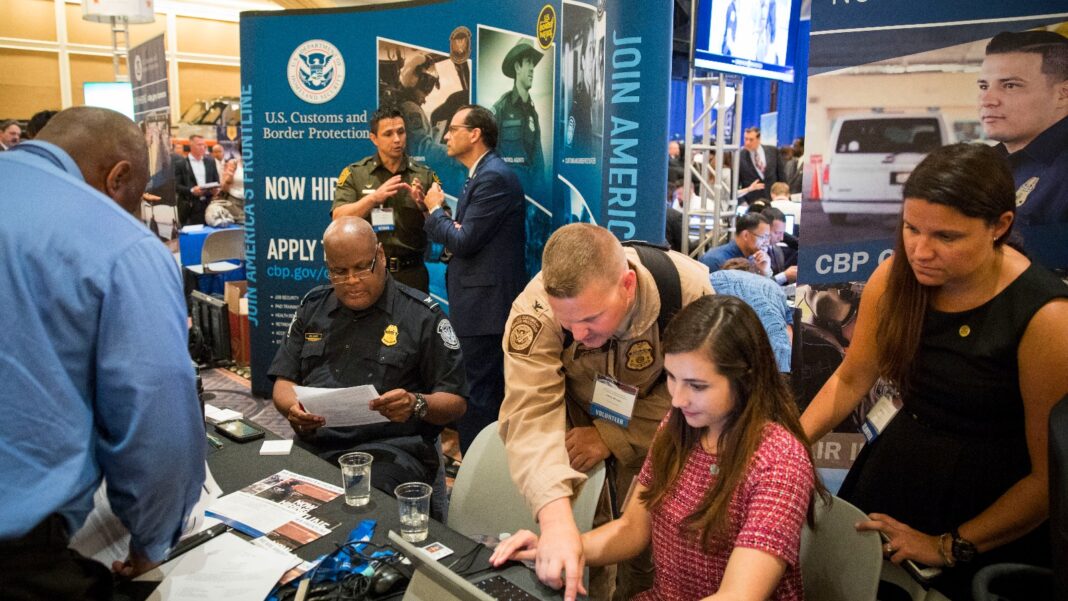
Featured photo: Recruiters speak with job seekers at a federal hiring event in Washington, D.C., in 2017. Representative image; it does not show a JOLTS survey establishment. Photo: U.S. Customs and Border Protection (James Tourtellotte), via Wikimedia Commons (Public domain). Cropped from the original.





.jpg)