



Metro Atlanta’s economy is often summarized through its most visible announcements: a new headquarters, a data center, a technology expansion. Those stories are real, but they describe a small slice of a labor market of more than 3.1 million payroll jobs. The Bureau of Labor Statistics’ industry data for the Atlanta-Sandy Springs-Roswell metro area give a fuller picture, and the latest figures show two things at once: the job base is broad, and over the past year nearly all of the net growth has come from one place, health care.
All figures below are from the BLS Current Employment Statistics program for the metro area, are not seasonally adjusted and compare August 2026 (preliminary) with August 2025. Comparing the same month a year apart avoids most seasonal distortion. The August figures will be revised, including in the annual benchmark process.
A broad base, not a single-industry economy
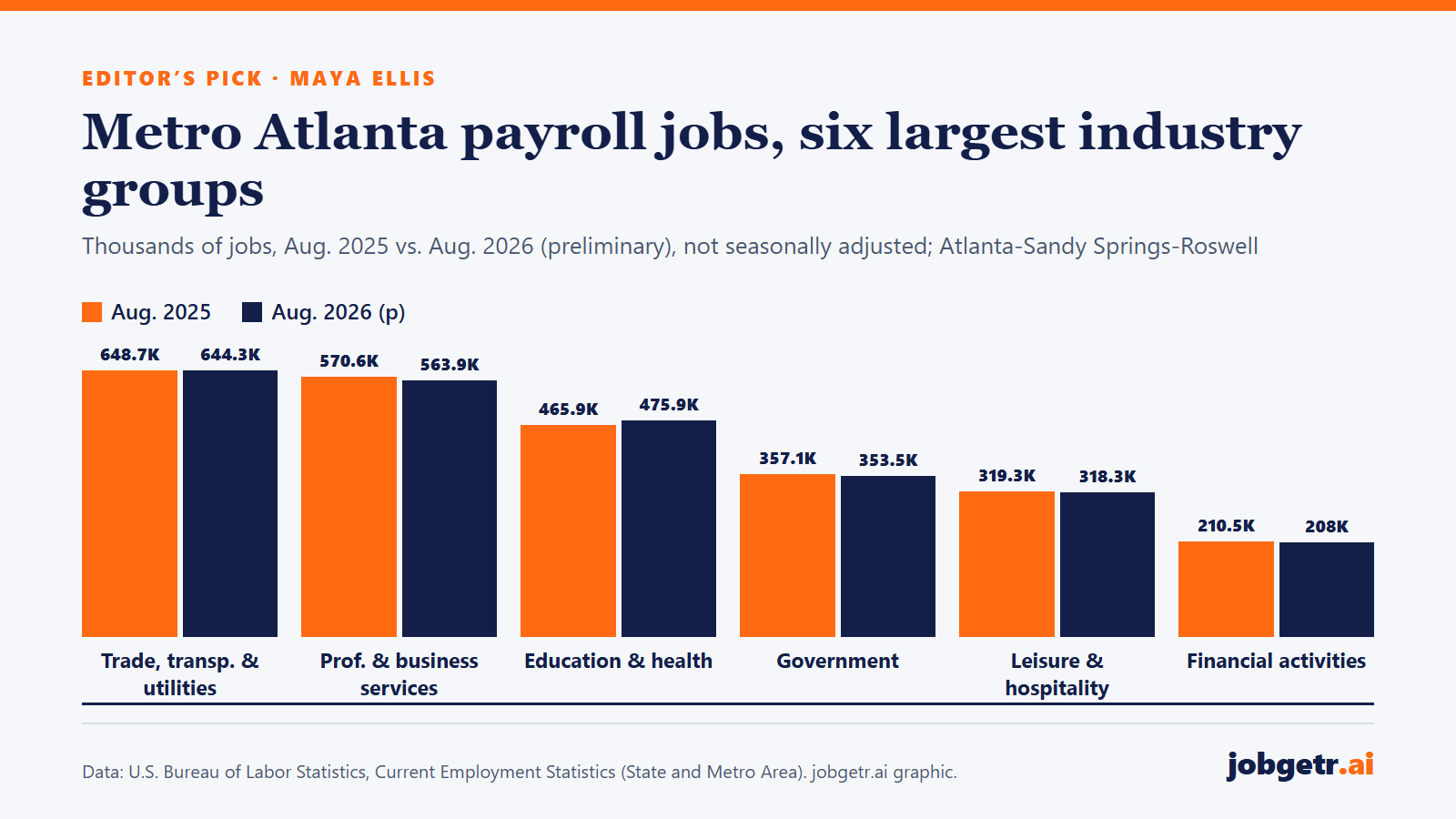
In August 2026 the metro had about 3,105,100 nonfarm payroll jobs. No single supersector accounted for more than about a fifth of them:
- Trade, transportation and utilities: 644,300 jobs, 20.7% of the total
- Professional and business services: 563,900, 18.2%
- Education and health services: 475,900, 15.3%
- Government: 353,500, 11.4%
- Leisure and hospitality: 318,300, 10.3%
- Financial activities: 208,000, 6.7%
- Manufacturing: 177,200, 5.7%
- Construction: 154,900, 5.0%
- Other services: 106,100, 3.4%
- Information: 100,700, 3.2%
The information sector, which includes software publishing, telecommunications and data processing, is the category most often equated with “tech,” and it is the smallest of the major private supersectors listed here. That comparison needs a caveat. Much technology work sits elsewhere, including computer systems design within professional, scientific and technical services, and technology roles inside banks, retailers and logistics companies. Industry data classify employers, not jobs, so they cannot measure the full size of the technology workforce. What they do show is that the metro’s employment base rests on distribution, business services, health care, education, public services and hospitality at least as much as on any single high-profile industry.
Where the past year’s change came from
Total payroll employment fell by about 14,300 jobs, or 0.5%, from August 2025 to August 2026. The BLS metro release for July had shown a smaller year-over-year dip of 0.1%. Beneath the total, the pattern was uneven.
Education and health services added about 10,000 jobs, a 2.1% increase, and was the only supersector with a meaningful gain. Within it, health care and social assistance rose by about 11,700, or 3.0%, to 402,600 jobs, about 13.0% of all payroll employment. Private education services slipped slightly.
Most other supersectors shrank. Professional and business services lost about 6,700 jobs (1.2%), with professional, scientific and technical services down about 9,700 while administrative and support services gained about 2,800. Trade, transportation and utilities fell by about 4,400 (0.7%), almost entirely in transportation and warehousing, which declined by 4,400 to 189,300. Government was down about 3,600 (1.0%), construction about 3,400 (2.1%), other services about 2,700 (2.5%) and financial activities about 2,500 (1.2%). Leisure and hospitality and manufacturing were down slightly, and information edged up by about 500.
Put another way, excluding health care and social assistance, metro payrolls were about 26,000 jobs lower than a year earlier. Health care growth offset roughly half of that decline.
Announcements are a different measure
Economic-development announcements answer a different question from payroll data. Georgia’s Office of the Governor reported that fiscal-year 2026 brought $35.2 billion in committed investment and about 25,300 expected new private-sector jobs statewide. It also reported that 75% of expansion and new-location projects were outside the 10-county metro Atlanta region, with $5.3 billion of investment in metro Atlanta, and that manufacturing accounted for 67% of the new jobs statewide.
Those figures are commitments that companies expect to fulfill over time, not jobs already counted on payrolls. They are also statewide except where the release says otherwise, and the governor’s 10-county metro region is not the same as the BLS metropolitan area. The two measures should be shown side by side, clearly labeled, rather than blended into a single growth story.
What this means for employers and workers
For employers, the numbers argue for sector-specific labor planning. A hospital system and a logistics operator in the same metro faced different conditions over the past year: one was in the only large sector adding jobs, the other in a sector that shed them. Metro-wide averages hide that difference.
For workers, especially those weighing a move between industries, health care’s growth is the clearest signal in the local payroll data. Declines in professional and technical services and in transportation and warehousing are worth watching, though one year of preliminary, unadjusted data does not establish a trend.
For local policymakers, the gap between announcement-driven narratives and payroll data is a reminder to evaluate economic strategy against realized employment, industry by industry.
What to watch next
- Revisions to the preliminary August estimates, and the annual benchmark revision to state and metro payroll data.
- Whether health care keeps adding jobs at a pace near 3% a year, and whether any other supersector returns to growth.
- Whether the declines in professional, scientific and technical services and in transportation and warehousing persist over several months.
- How many of the fiscal-year 2026 commitments located in metro Atlanta show up in payroll counts over the coming years.
Sources
- U.S. Bureau of Labor Statistics, “Economy at a Glance: Atlanta-Sandy Springs-Roswell, GA (CES State and Metro Area employment by industry, not seasonally adjusted),” 2026-09-18. https://www.bls.gov/eag/eag.ga_atlanta_msa.htm
- U.S. Bureau of Labor Statistics, “State and Metro Area Employment, Hours, and Earnings (CES) series SMU13120600000000001 and supersector/sector series for Atlanta-Sandy Springs-Roswell, via BLS Public Data API,” 2026-09-18. https://data.bls.gov/timeseries/SMU13120600000000001
- U.S. Bureau of Labor Statistics, “Metropolitan Area Employment and Unemployment — July 2026,” 2026-09-02. https://www.bls.gov/news.release/metro.nr0.htm
- Georgia Office of the Governor, “Gov. Kemp Announces Another Record-Breaking Year for Economic Development,” 2026-09-03. https://gov.georgia.gov/press-releases/2026-09-03/gov-kemp-announces-another-record-breaking-year-economic-development
Featured photo: Grady Memorial Hospital in Atlanta. Health care and social assistance added about 11,700 metro Atlanta jobs over the past year. Photo: Warren LeMay from Cincinnati, OH, United States, via Wikimedia Commons (CC0). Resized from the original.





.jpg)