
Metro Atlanta is often mentioned as a place where artificial-intelligence work is taking root. It is a fair question to ask of a regional economy where professional and business services employ more than half a million people. But a fair question is not a measured answer. A review of the public, primary-source data finds useful pieces of the picture and one large gap: no official statistical series currently counts AI hiring for Atlanta or any other metro area.
That matters because claims about regional AI leadership travel quickly and are hard to check. This piece sets out what can be measured today, what cannot, and what a credible local map of AI hiring would require.
What the public data can show
The baseline labor market. The Bureau of Labor Statistics put the Atlanta-Sandy Springs-Roswell unemployment rate at 3.2% in July 2026 (preliminary, not seasonally adjusted), down from 3.4% in July 2025. Payroll employment is flatter. The BLS July metro release showed nonfarm jobs down 0.1% from a year earlier, and the preliminary August estimate published since shows about 3.105 million jobs, roughly 14,300 (0.5%) fewer than in August 2025. A metro with falling unemployment and a flat-to-softer payroll count is not an obvious candidate for a hiring boom in any field.
The industries closest to AI work. Industry data can only approximate technology activity. The information sector, which includes software publishing, telecommunications and data processing, employed about 100,700 people in the metro in August 2026 (preliminary), up about 500 from a year earlier. Professional, scientific and technical services, which includes computer systems design and consulting, employed about 264,700, down about 9,700, or 3.5%, over the same period. Neither series identifies jobs that involve AI, and both mix AI-adjacent work with much else.
The stock of technical occupations. The BLS Occupational Employment and Wage Statistics program estimated 119,150 computer and mathematical jobs in metro Atlanta in May 2025, or about 41 per 1,000 jobs. Its location quotient, which compares a metro’s occupational concentration with the national average, was 1.22, meaning those jobs were about 22% more concentrated in Atlanta than nationally. Data scientists, the occupation most directly tied to machine-learning work, numbered 6,820, with a location quotient of 1.40.
Peer comparisons put those numbers in context. Using the same survey and occupation definition, the location quotient for computer and mathematical occupations was 2.20 in Washington-Arlington-Alexandria, 1.43 in Dallas-Fort Worth-Arlington, 1.35 in Charlotte-Concord-Gastonia, 0.75 in Houston and 0.73 in Miami. Atlanta has an above-average technical workforce, but in this small comparison set it is not the most concentrated. These are employment levels at one point in time, not hiring, and they say nothing about how much of the work involves AI.
Business AI use: Atlanta firms and their peers
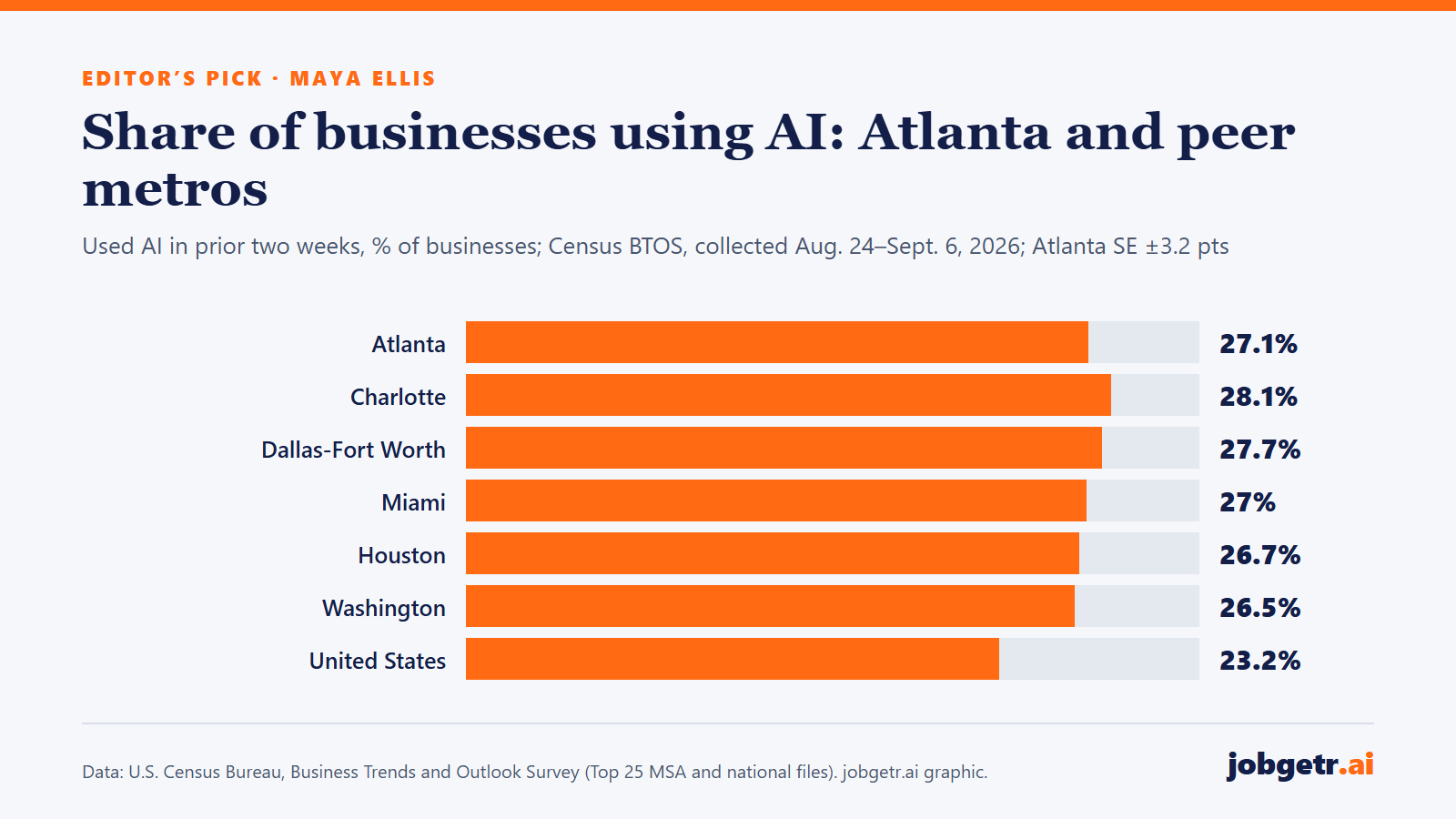
The closest official local measure of AI activity is the Census Bureau’s Business Trends and Outlook Survey, which publishes estimates for the 25 most populous metro areas. In the survey collected Aug. 24 to Sept. 6, 2026, 27.1% of Atlanta-area businesses said they had used AI in a business function in the previous two weeks. Nationally, the figure was 23.2%.
The Atlanta estimate carries a standard error of about 3.2 percentage points, which implies a 90% confidence interval of roughly 22% to 32%. By our calculation from the published standard errors, the gap between Atlanta and the national estimate is not statistically distinguishable at that level. Several peers reported similar shares: Charlotte 28.1%, Dallas-Fort Worth 27.7%, Miami 27.0%, Houston 26.7% and Washington 26.5%. Atlanta’s own estimate has moved around from cycle to cycle, at 31.4% and 29.7% in the two preceding survey periods.
Two cautions apply. The survey counts the share of businesses using AI, not the number of workers affected or hired. And a business that uses an AI tool may hire no one new because of it.
What the data do not show
The missing piece is hiring itself. The BLS Job Openings and Labor Turnover Survey, which measures openings and hires, publishes national and state estimates but not metro estimates, and it does not classify jobs by AI content. Private job-posting datasets can flag AI-related postings, but a posting is an advertisement, not a hire, and those datasets were not verified for this piece.
National research is informative but cannot be localized. Stanford Digital Economy Lab researchers, using ADP payroll data, report that employment of workers ages 22 to 25 in highly AI-exposed occupations was about 19% below expected levels relative to less-exposed peers, with the adjustment coming mainly through reduced hiring of young workers. A separate Stanford working paper covering 41 countries finds that the junior share of the workforce fell at foreign affiliates of AI-adopting firms, driven mainly by growth in senior employment. Both studies describe patterns in large samples; neither says anything specific about Atlanta.
Finally, announcements are not jobs. Georgia’s Office of the Governor reported $5.3 billion in fiscal-year 2026 economic-development investment in metro Atlanta, and 25,300 expected new jobs statewide. Those are company commitments, not jobs counted on payrolls, and the release does not identify which, if any, are AI roles.
What employers, workers and policymakers can take from this
For employers benchmarking against other metros, the defensible comparisons today are occupational concentration from BLS and business AI use from the Census Bureau, each with its limits stated. Claims that Atlanta leads the Southeast in AI hiring cannot be supported or refuted with public data.
For workers, the practical signal is narrower than the headlines. Technical occupations are more concentrated in Atlanta than nationally, but the industries that house much of that work were flat or down over the past year, and national research points to entry-level hiring as the place where AI adjustment shows up first.
For local officials and economic developers, a credible map would need a fixed occupation definition, a stated peer set, a way to separate postings from completed hires, and a record of which announced projects turn into payroll jobs. We will watch the Census survey’s biweekly updates, the next monthly BLS metro release and the next annual occupational estimates, and we will update this analysis when a verifiable local measure of AI hiring exists.
Sources
- U.S. Bureau of Labor Statistics, “Metropolitan Area Employment and Unemployment — July 2026,” 2026-09-02. https://www.bls.gov/news.release/metro.nr0.htm
- U.S. Bureau of Labor Statistics, “Table 1. Civilian labor force and unemployment by state and metropolitan area (Metropolitan Area Employment and Unemployment, July 2026),” 2026-09-02. https://www.bls.gov/news.release/metro.t01.htm
- U.S. Bureau of Labor Statistics, “Economy at a Glance: Atlanta-Sandy Springs-Roswell, GA (CES State and Metro Area employment, not seasonally adjusted),” 2026-09-18. https://www.bls.gov/eag/eag.ga_atlanta_msa.htm
- U.S. Bureau of Labor Statistics, “Occupational Employment and Wage Statistics, May 2025, Atlanta-Sandy Springs-Roswell, GA (series OEUM0012060000000150000xx, OEUM0012060000000152051xx via BLS Public Data API),” 2026. https://www.bls.gov/oes/current/oes_12060.htm
- U.S. Census Bureau, “Business Trends and Outlook Survey, Top 25 MSA and National data files (AI use, question 7; collection Aug. 24–Sept. 6, 2026),” 2026-09-10. https://www.census.gov/hfp/btos/data_downloads
- Stanford Digital Economy Lab, “How Does AI Change Labor Demand? Evidence from 41 Countries (Bharat Chandar, Bouke Klein Teeselink),” 2026-09-21. https://digitaleconomy.stanford.edu/publication/how-does-ai-change-labor-demand/
- Stanford Digital Economy Lab, “No Widespread Displacement, but the AI Employment Gap for Young Workers Has Widened to 19%,” 2026-08-12. https://digitaleconomy.stanford.edu/news/canariesaug26/
- Georgia Office of the Governor, “Gov. Kemp Announces Another Record-Breaking Year for Economic Development,” 2026-09-03. https://gov.georgia.gov/press-releases/2026-09-03/gov-kemp-announces-another-record-breaking-year-economic-development
Featured photo: Tech Square Labs in Technology Square, Midtown Atlanta. Photo: JJonahJackalope, via Wikimedia Commons (CC BY-SA 4.0). Resized from the original.