
Job advertisements are among the fastest and most detailed signals in labor-market data. They show which occupations employers are recruiting for, which skills they request and, increasingly, whether a role involves artificial intelligence. They are also easy to misread. A posting is not an opening, an opening is not a hire, and none of the three maps one-to-one onto the others.
Three different things
A posting is an advertisement. A BLS Monthly Labor Review article published in August 2026 notes that employers can post positions across numerous online platforms, countries, regions, states and cities, and that vacancy postings may sometimes be left online after the position has been filled. One position can generate several postings, and a posting can outlive the vacancy behind it.
A job opening, as defined by the BLS Job Openings and Labor Turnover Survey, or JOLTS, meets three conditions: a specific position exists and there is work available for it, the job could start within 30 days, and the employer is actively recruiting workers from outside the establishment. Active recruiting can mean online advertising, but it also covers help-wanted signs, word of mouth, job fairs and employment agencies. Openings are counted on the last business day of the month, so they are a stock. JOLTS collects these data directly from a sample of about 21,000 establishments; it is not built from online listings.
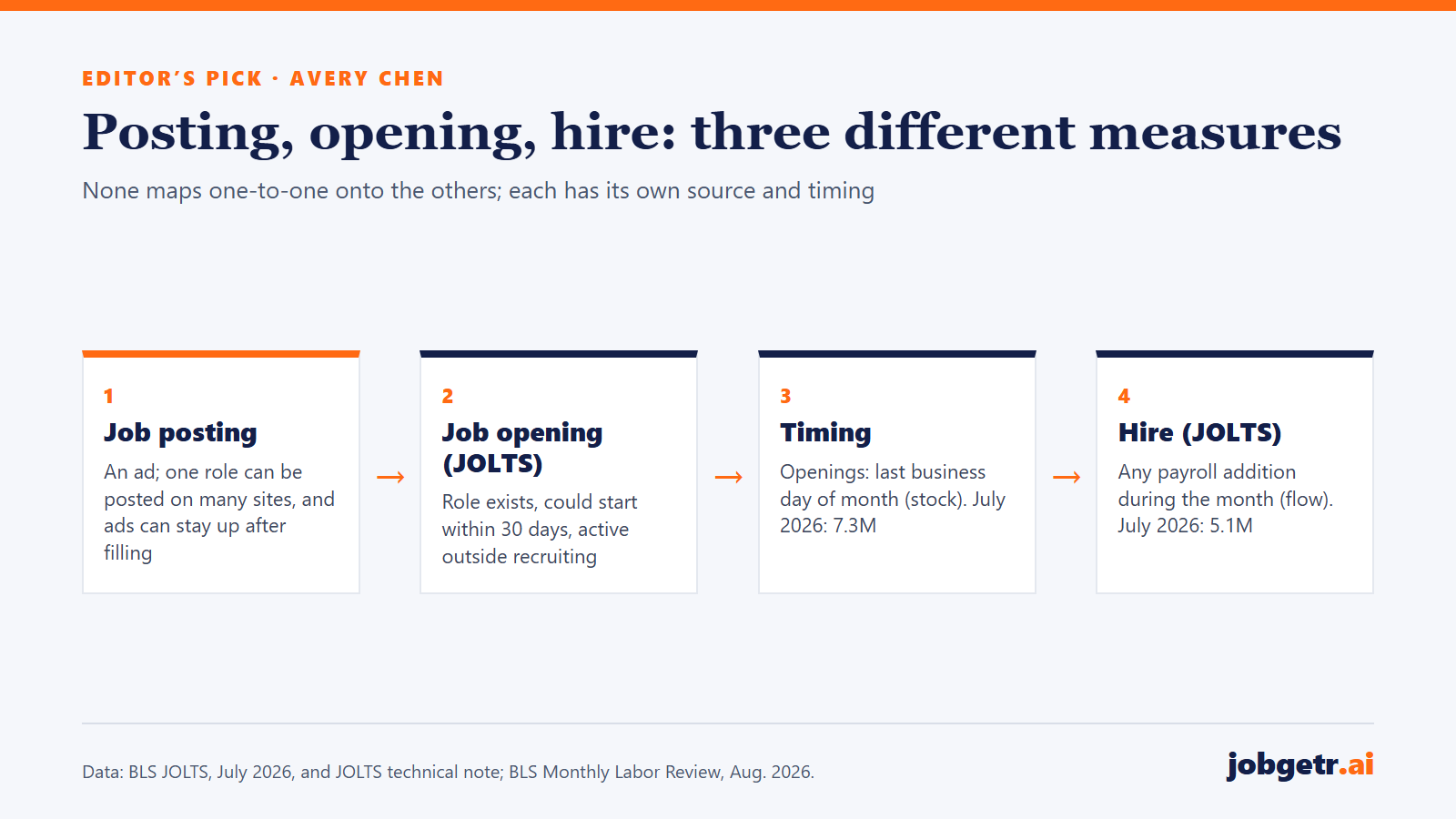
A hire is any addition to the payroll during the entire month, including rehires and short-term and seasonal workers. Hires are a flow.
In July 2026, JOLTS recorded 7.3 million openings and 5.1 million hires. The difference between those figures is not a count of jobs that went unfilled, and their ratio is not a conversion rate. They measure different things over different reference periods. A position opened and filled within the same month may never appear in a month-end openings count, even though its hire is counted. An opening counted at the end of July may be filled in August, later or not at all. Posting counts add a third layer, with their own timing and duplication.
Why postings are still valuable
None of this makes posting data useless. Postings carry detail the official surveys do not: job titles, requested skills and tools, and sometimes posted pay. They are available quickly and at fine occupational and geographic detail.
The Stanford Digital Economy Lab working paper released this month by Bharat Chandar and Bouke Klein Teeselink shows both the value and the discipline required. The authors analyze 1.25 billion job postings and 154 million employment records across 41 countries, inferring company AI adoption from job advertisements that involve generative-AI use. They do not treat postings as hires. Postings classify which companies adopted AI; employment outcomes come from a separate source, worker profiles drawn predominantly from LinkedIn by the workforce-analytics provider Revelio Labs. They find that foreign affiliates of AI-adopting companies reduced the junior share of their workforce relative to comparable control affiliates, mainly because senior employment grew.
The paper is also explicit about the limits of posting-based measurement:
- Job advertisements likely lag actual AI adoption, and companies that use AI without ever advertising AI roles count as non-adopters. The authors say this likely biases their estimates toward zero.
- Their country rankings reflect which entities advertise on LinkedIn as much as how intensively they adopt AI, so the authors describe them as showing where AI hiring is happening on LinkedIn, not national adoption rates.
- LinkedIn profiles over-represent managers and professionals and under-represent agriculture, construction and manual labor. In the United States, active positions in the data are roughly two-thirds as large as official employment.
- AI jobs make up only 0.60% of job postings at adopting companies.
That is what careful use of posting data looks like: a defined question, a separate outcome measure and disclosed coverage gaps.
What goes wrong when postings stand in for hiring
The common mistakes follow from the definitions. A rise in postings can be read as a hiring surge when it may partly reflect more platforms, reposting or listings left up longer. A fall in postings can be read as layoffs, although separations are measured separately. A skill that appears in more advertisements can be read as a skill employers are paying more for, although postings record what is requested, not who is hired or at what wage. And counts from a single platform can be read as national totals, although coverage differs by occupation, industry and country.
None of these errors requires bad data. They come from asking a posting count to answer a question it was not built to answer.
What it means for employers and workers
For employers benchmarking against competitors, posting volumes indicate recruiting activity, not headcount growth. They are more useful when paired with payroll data, JOLTS hires and a company’s own applicant and hiring records.
For job seekers, many postings in a field signal employer interest, not a guaranteed number of offers. The Stanford payroll research published in August, which finds that AI-related adjustment for workers ages 22 to 25 in highly exposed occupations is showing up mainly as reduced hiring rather than increased separations, is a reminder to watch hiring outcomes, not only advertisements.
The standard readers should expect from any posting-based figure, including ours, is simple: state the source and date, say how duplicates and stale listings were handled, report it separately from JOLTS openings and hires, and disclose coverage limits. A precise-looking real-time hiring count without those disclosures is less informative than it appears.
What to watch next: the next JOLTS release, which will show whether July’s openings and hires hold, and further work that tests posting-based AI adoption measures against employment outcomes.
Sources
- U.S. Bureau of Labor Statistics, “Job Openings and Labor Turnover Summary — July 2026,” 2026-09-01. https://www.bls.gov/news.release/jolts.nr0.htm
- U.S. Bureau of Labor Statistics, “Job Openings and Labor Turnover Technical Note,” 2026-09-01. https://www.bls.gov/news.release/jolts.tn.htm
- U.S. Bureau of Labor Statistics, Monthly Labor Review (Akinyooye, Crankshaw, McIllece), “Debunking common misconceptions about the Job Openings and Labor Turnover Survey,” 2026-08. https://www.bls.gov/opub/mlr/2026/article/debunking-common-misconceptions-about-the-job-openings-and-labor-turnover-survey-bls-research-disproves-overcounting-and-other-myths-in-jolts-data.htm
- Stanford Digital Economy Lab (Chandar, Klein Teeselink), “How Does AI Change Labor Demand? Evidence from 41 Countries (publication page),” 2026-09-21. https://digitaleconomy.stanford.edu/publication/how-does-ai-change-labor-demand/
- Stanford Digital Economy Lab (Chandar, Klein Teeselink), “How Does AI Change Labor Demand? Evidence from 41 Countries (working paper PDF),” 2026-09-20. https://digitaleconomy.stanford.edu/app/uploads/2026/09/HowDoesAIChangeLaborDemand.pdf
- Stanford Digital Economy Lab, “No Widespread Displacement, but the AI Employment Gap for Young Workers Has Widened to 19%,” 2026-08-12. https://digitaleconomy.stanford.edu/news/canariesaug26/
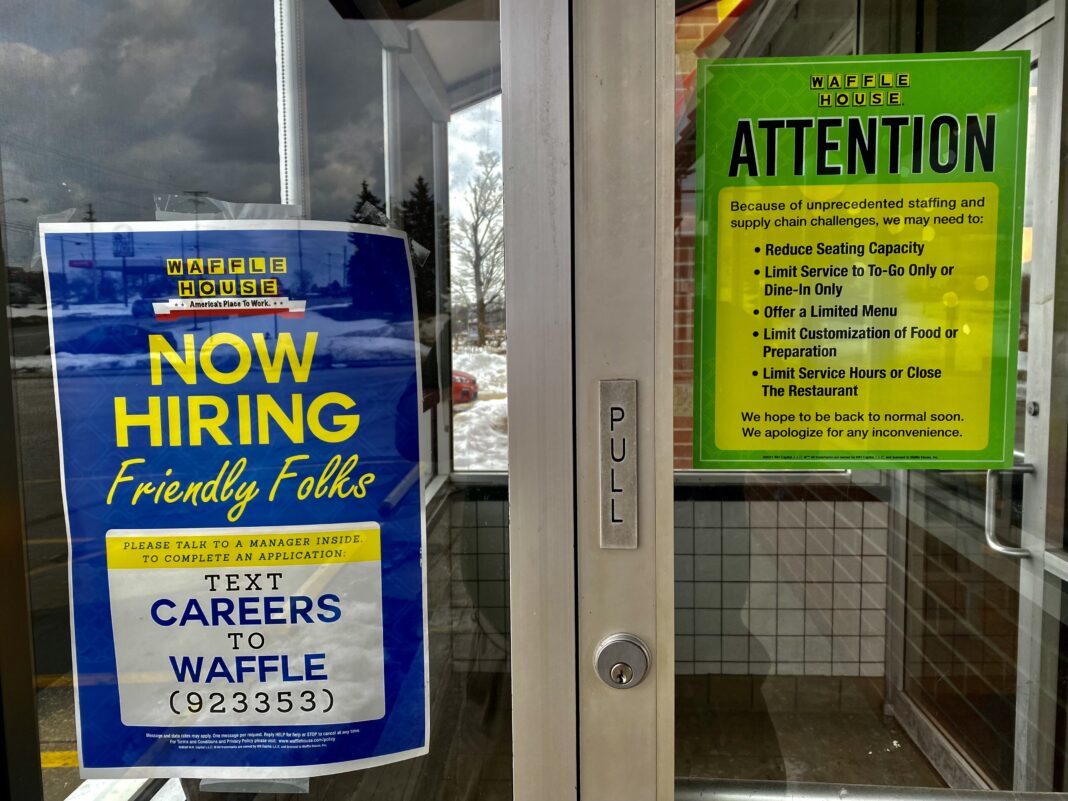
Featured photo: Hiring signage at a Waffle House in Austinburg Township, Ohio (2022). Job postings signal recruiting activity, not completed hires. Photo: Andre Carrotflower, via Wikimedia Commons (CC BY-SA 4.0). Resized from the original.