


Labor productivity, output per hour worked, can rise in two ways. Output can grow faster than hours, or hours can fall faster than output. Only the second involves doing the same work with less labor. The distinction is often lost when productivity gains, especially those linked to AI, are discussed as if they were a forecast of layoffs.
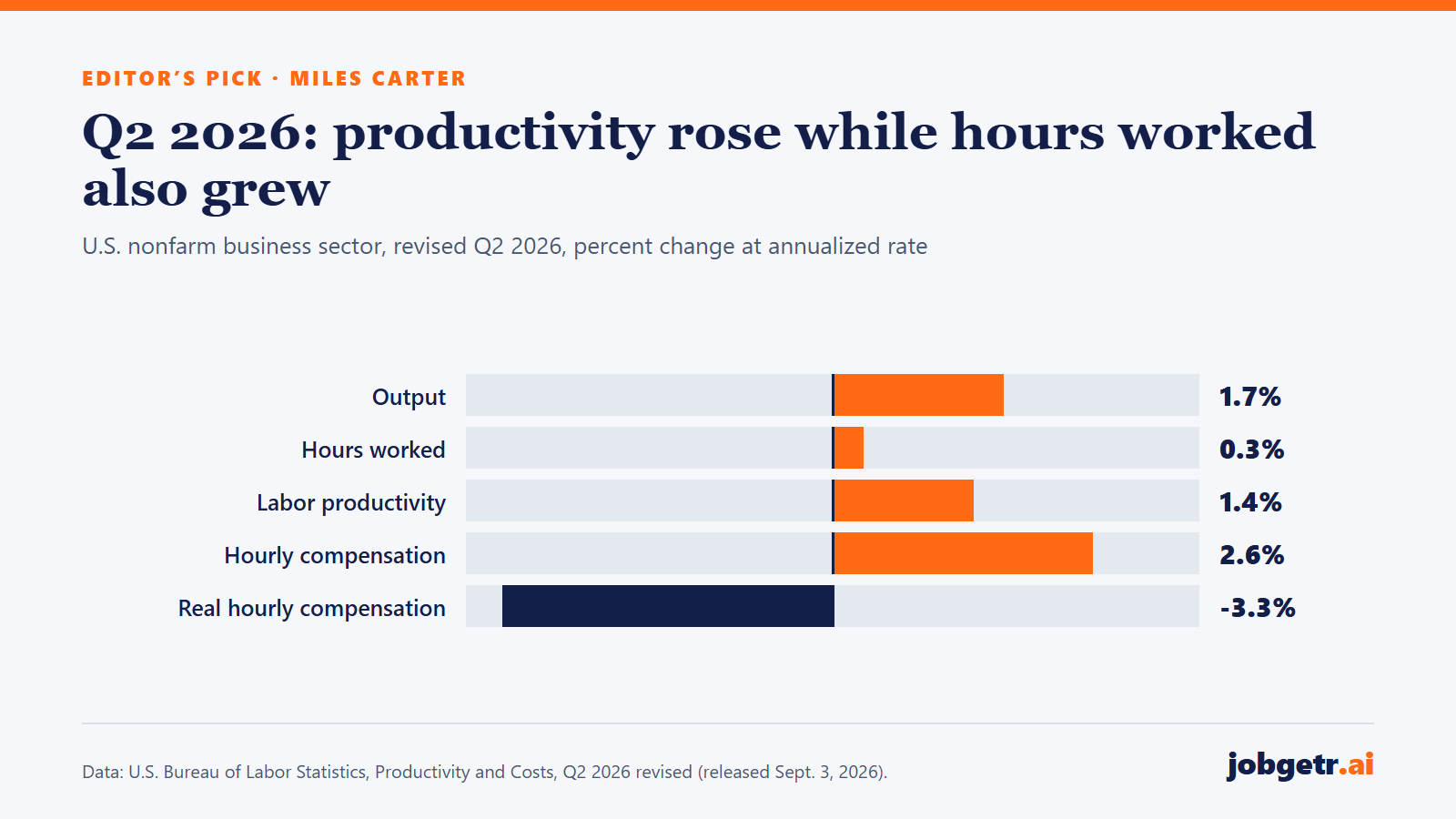
The latest national data illustrate the first path. In the revised second-quarter report released September 3, the Bureau of Labor Statistics said nonfarm business labor productivity rose at a 1.4% annualized rate as output increased 1.7% and hours worked increased 0.3%. Productivity rose while total hours grew.
What the second-quarter numbers say
Over the four quarters ending in the second quarter of 2026, productivity rose 2.2%. The same release carries a caution about who benefits. Hourly compensation rose at a 2.6% annualized rate in the quarter, but real hourly compensation fell at a 3.3% rate once consumer prices are taken into account, and unit labor costs rose 1.2%. Over four quarters, real hourly compensation fell 0.1%.
BLS also reported that the labor share, the portion of nonfarm business output paid to workers as compensation, fell to 52.8% in the second quarter, “the lowest level in the series, which begins in the first quarter of 1947.”
These are aggregate measures. They cannot tell us which technology, industry or management decision drove the change, and quarterly annualized rates can move sharply from one quarter to the next. We do not attribute the second-quarter gain to AI, and BLS does not. What the numbers establish is narrower and still useful: higher productivity and more hours worked occurred together, and higher productivity did not translate into higher real hourly compensation in this period.
What firm-level AI evidence shows
Firm surveys give a closer view of AI specifically. An April 2026 Census Bureau working paper, based on a detailed AI supplement to the Business Trends and Outlook Survey covering November 2025 to January 2026, asked AI-using firms whether AI had changed their employment over the prior six months. On a firm-weighted basis, 95.7% reported no change, 2.3% reported an increase and 2.0% reported a decrease. Weighted by employment, the shares were 93.9%, 3.7% and 2.4%. Among firms reporting any effect of AI on worker tasks, 66% said AI only augmented those tasks.
The authors are careful about what this means. The survey captures net employment change, not its size, and the paper notes that it provides no information on gross worker flows, such as AI-driven changes in hiring. It also finds that firms using AI across more business functions, or making larger operational investments to implement it, are more likely to report employment declines, an association the authors do not interpret causally.
Research on composition fills in part of that gap. A September 21, 2026 Stanford Digital Economy Lab working paper by Bharat Chandar and Bouke Klein Teeselink, covering 41 countries, 1.25 billion job postings and 154 million employment records, found that the junior share of the workforce fell at foreign affiliates of AI-adopting firms relative to control affiliates. That shift was driven mainly by growth in senior employment rather than shrinking junior employment, and the authors report suggestive evidence of modest overall employment growth.
In the United States, an August 12, 2026 Stanford update by Erik Brynjolfsson, Bharat Chandar and Ruyu Chen, using ADP payroll data, found employment of workers ages 22 to 25 in highly AI-exposed occupations about 19% below expected relative to less-exposed peers, up from 15% in July 2025. The adjustment came “primarily through reduced hiring of young workers rather than increased separations,” and experienced workers showed no comparable gap. The authors also wrote, “We do not see widespread, economy-wide job displacement associated with AI,” and describe their results as “descriptive patterns, not causal estimates.”
What it means for employers and workers
Taken together, the evidence argues against both blanket predictions. Productivity gains have not required aggregate headcount cuts in the latest data, and AI-driven net employment changes remain rare among firms using the technology. But stable headcount can conceal real change: fewer entry-level hires, more senior staff, different tasks inside the same job titles.
For employers, that points to measuring several things separately rather than treating headcount as the single outcome of an AI project:
- Output and quality, including error rates, not only speed.
- Staffing mix by career stage, since composition can shift while totals stay flat.
- Recruitment, including entry-level requisitions that quietly go unfilled.
- Pay, since national data show productivity and real compensation can diverge.
For workers, the relevant question is less whether an employer is cutting jobs than where it is still hiring. The research above suggests that early-career entry points in highly AI-exposed occupations are where adjustment has shown up so far.
What to watch next
Three data streams will test this reading. The next BLS productivity release will show whether output keeps outpacing hours and whether the labor share recovers. Monthly BLS job openings and hires data can show whether hiring, rather than layoffs, is where adjustment occurs. And the Census Bureau is planning questions on AI’s effects on hiring for its next AI supplement, pending approval from the Office of Management and Budget, which could provide the gross-flow evidence the current survey lacks.
Sources
- U.S. Bureau of Labor Statistics, “Productivity and Costs, Second Quarter 2026, Revised,” 2026-09-03. https://www.bls.gov/news.release/prod2.nr0.htm
- U.S. Census Bureau, Center for Economic Studies, “The Microstructure of AI Diffusion: Evidence from Firms, Business Functions, and Worker Tasks (CES-WP-26-25; Bonney, Breaux, Dinlersoz, Foster, Haltiwanger, Pande),” 2026-04. https://www.census.gov/library/working-papers/2026/adrm/CES-WP-26-25.html
- Stanford Digital Economy Lab, “How Does AI Change Labor Demand? Evidence from 41 Countries (Bharat Chandar, Bouke Klein Teeselink), working paper,” 2026-09-21. https://digitaleconomy.stanford.edu/publication/how-does-ai-change-labor-demand/
- Stanford Digital Economy Lab, “No Widespread Displacement, but the AI Employment Gap for Young Workers Has Widened to 19% (Erik Brynjolfsson, Bharat Chandar, Ruyu Chen),” 2026-08-12. https://digitaleconomy.stanford.edu/news/canariesaug26/
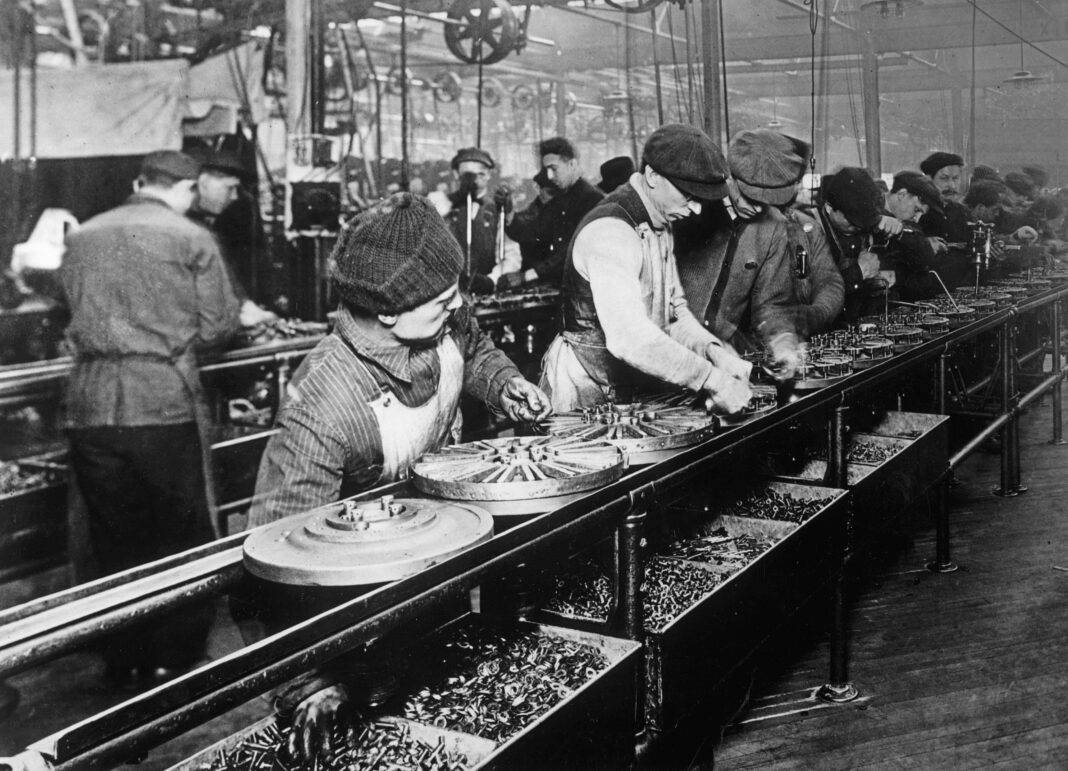
Featured photo: The Ford Motor Company assembly line in 1913, an early example of output per hour rising without cutting the workforce. Historical image. Photo: Unknown author (Ford Motor Company, 1913; public domain), via Wikimedia Commons (Public domain). Resized from the original.





.jpg)