


Labor Market
The Atlanta-Sandy Springs-Roswell metro area’s labor force grew by about 69,000 people over the past year, but the number of jobs located in the region did not keep pace, and the metro’s unemployment rate edged up to 3.5% in September from 3.4% a year earlier, according to Bureau of Labor Statistics data released Wednesday, Oct. 28.
The civilian labor force, which counts residents who are working or looking for work, reached 3,387,001 in September, up from 3,317,861 in September 2025, a gain of 69,140, or 2.1%. The number of employed residents rose by 62,899 to 3,268,658. The number of unemployed residents rose faster in percentage terms, by 6,241, or 5.6%, to 118,343 from 112,102.
The figures are not seasonally adjusted, and the September 2026 values are preliminary. The rate was also 3.4% in August.
Payrolls were flat
The payroll count, which measures jobs at employers located in the metro area regardless of where the workers live, tells a different story. Nonfarm employment in metro Atlanta was 3,101,900 in September, down 2,700, or 0.1%, from 3,104,600 a year earlier. BLS counted only 11 metro areas nationwide with payroll increases over the year and three with decreases; Atlanta was in neither group, placing it among the 373 areas where employment was essentially unchanged.
The August payroll estimate has also been revised. The new table puts metro Atlanta at 3,107,500 jobs in August 2026, against 3,119,400 in August 2025, a year-over-year decline of 11,900. Payroll employment slipped by 5,600 from August to September, though the unadjusted month-to-month change includes normal seasonal movement.
The two series come from different surveys and are not directly comparable: one counts people by where they live, the other counts jobs by where the work is, so a resident who commutes to a job outside the metro shows up in one but not the other. Still, a labor force that grew 2.1% while local payrolls held steady is consistent with the slightly higher jobless rate: more people were looking for work in the region than a year ago.
How Atlanta compares with peer metros
Atlanta’s experience is different from several other large Southern and Sun Belt metros in the same release.
– Dallas-Fort Worth-Arlington: unemployment fell to 4.1% from 4.2%, and payrolls rose by 43,900, the largest gain of any metro area. Its labor force grew by 13,661. – Houston-Pasadena-The Woodlands: the rate fell to 4.6% from 4.8%; payrolls were 3,489,400, up from 3,455,800. – Charlotte-Concord-Gastonia: the rate fell to 3.3% from 3.9%, and payrolls rose by 25,400, the second-largest gain nationally. – Miami-Fort Lauderdale-West Palm Beach: the rate fell to 3.2% from 3.6%, with the labor force up 31,012. – Nashville-Davidson-Murfreesboro-Franklin: the rate fell to 2.8% from 3.0%.
Among those peers, Atlanta was the only one whose unemployment rate rose, and its labor-force gain of 69,140 was larger than Dallas-Fort Worth’s, Houston’s, Charlotte’s and Miami’s combined. Atlanta’s 3.5% rate was still below the 4.0% national rate on the same unadjusted basis, and below Dallas-Fort Worth’s and Houston’s.
Atlanta was also one of 21 large metro areas, those with at least 1 million residents in the 2020 Census, where the unemployment rate rose from a year earlier; 31 large metros saw declines.
What it means for job seekers
For people looking for work in metro Atlanta, the data point to more competition for a roughly unchanged number of local jobs. The increase in the jobless rate is small, a tenth of a point, and the rate remains below the national figure, but about 118,000 metro residents were unemployed and looking for work in September, roughly 6,200 more than a year earlier.
These are metro-area figures. They should not be read as Georgia statewide numbers or as figures for the city of Atlanta, which is only one part of the metropolitan area. BLS will publish October metro data on Dec. 2.
Sources
- U.S. Bureau of Labor Statistics, “Table 1. Civilian labor force and unemployment by state and metropolitan area,” October 28, 2026. https://www.bls.gov/news.release/metro.t01.htm
- U.S. Bureau of Labor Statistics, “Table 3. Employees on nonfarm payrolls by state and metropolitan area, not seasonally adjusted,” October 28, 2026. https://www.bls.gov/news.release/metro.t03.htm
- U.S. Bureau of Labor Statistics, “Metropolitan Area Employment and Unemployment — September 2026,” October 28, 2026. https://www.bls.gov/news.release/metro.nr0.htm
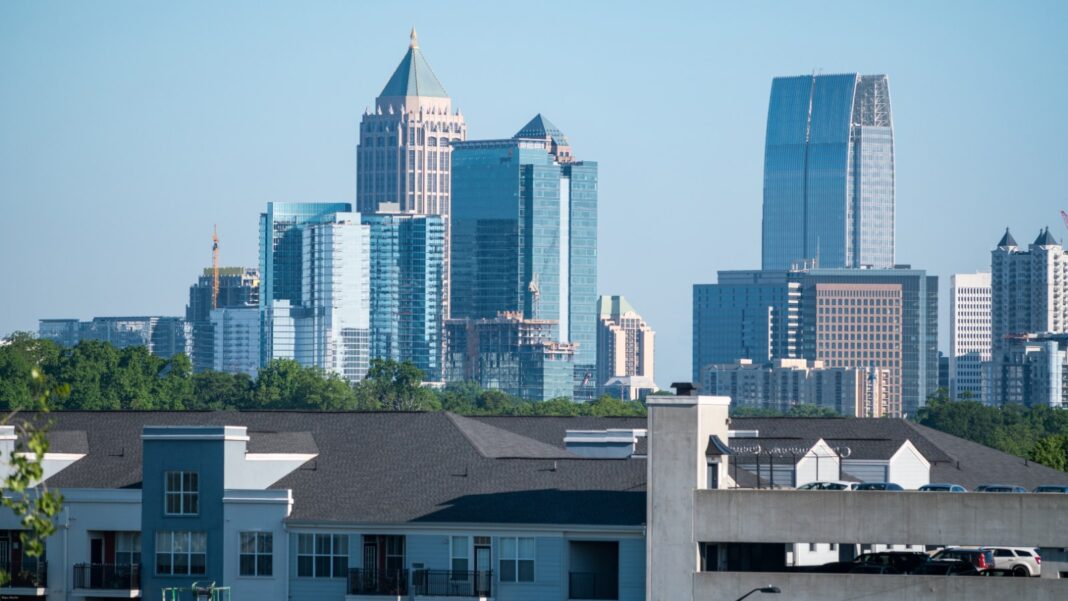
Featured photo: The Midtown Atlanta skyline, including One Atlantic Center and 1180 Peachtree, viewed from Freedom Parkway above the Eastside BeltLine Trail, May 22, 2016. Representative image of the Atlanta metro area. Photo: Marc Merlin, via Wikimedia Commons (CC BY-SA 4.0). Cropped from the original.