
Labor Market
New applications for U.S. unemployment benefits stayed under 200,000 for a fifth consecutive week, a sign that employers are still laying off relatively few workers even as hiring remains slow. Seasonally adjusted initial claims were 199,000 in the week ending Oct. 10, up 1,000 from the prior week, the Labor Department said in its weekly report released Thursday, Oct. 15.
The prior week’s figure was revised up by 1,000, from 197,000 to 198,000. The four-week moving average, which smooths out week-to-week noise, rose by 250 to 198,500. A year earlier, in the comparable week of 2025, initial claims stood at 222,000 and the four-week average at 224,750.
Claims have now been below 200,000 every week since the week ending Sept. 12, according to the department’s seasonally adjusted series as published by the Federal Reserve Bank of St. Louis. Before that, weekly readings from early August through early September ran between 200,000 and 212,000.
Continuing claims edge down
The number of people continuing to receive state unemployment benefits, reported with a one-week lag, was 1,710,000 in the week ending Oct. 3. That was down 4,000 from the prior week’s revised level of 1,714,000, which itself was revised down from 1,716,000. The insured unemployment rate held at 1.1%. A year earlier, insured unemployment was 1,928,000 and the rate was 1.3%.
Before seasonal adjustment, states reported 190,626 initial claims in the week ending Oct. 10, an increase of 19,456, or 11.4%, from the week before. The department’s seasonal factors had anticipated a rise of 18,799, so the unadjusted increase was close to the normal pattern for this time of year. Unadjusted claims were below the 210,777 filed in the same week last year.
Claims from former federal civilian employees, reported for the week ending Oct. 3, totaled 463, up 68 from the prior week but far below the 3,272 filed in the comparable week a year earlier. In the same week, California (+4,295), Illinois (+1,108) and New Jersey (+856) posted the largest increases in initial claims among states, before seasonal adjustment.
Why it matters for job seekers
Initial claims are one of the timeliest readings on layoffs, and this week’s report shows no sign that cuts are spreading across the economy. For people who already have jobs, that points to relatively stable footing.
Low claims do not mean hiring is strong, though. They count people who lose work and apply for benefits, not the number of openings or new hires. The most recent monthly jobs report, released Oct. 2, showed payrolls rising by just 29,000 in September, with the unemployment rate at 4.2%. That combination fits what economists call a low-hire, low-fire market: few layoffs for people in jobs, but fewer openings for people trying to get in or move up.
Continuing claims hovering near 1.7 million, lower than a year ago, suggest people already receiving benefits are not piling up. Still, they do not show how long it is taking job seekers who are not covered by unemployment insurance, such as new entrants to the workforce, to find work.
The catch
The headline numbers are advance estimates and are routinely revised the following week, as the prior week’s figure was this time. Weekly claims also swing around holidays, storms and seasonal hiring patterns, which is why the four-week average is a steadier gauge. A single week of data is not a trend, and a sustained move up in both initial and continuing claims would be the clearer sign that the slowdown in hiring is turning into broader job losses.
Sources
- U.S. Department of Labor, “Unemployment Insurance Weekly Claims,” October 15, 2026. https://www.dol.gov/ui/data.pdf
- Federal Reserve Bank of St. Louis (FRED), “Initial Claims (ICSA),” updated October 15, 2026. https://fred.stlouisfed.org/series/ICSA
- U.S. Bureau of Labor Statistics, Employment Situation news release for September 2026, October 2, 2026. https://www.bls.gov/news.release/empsit.nr0.htm
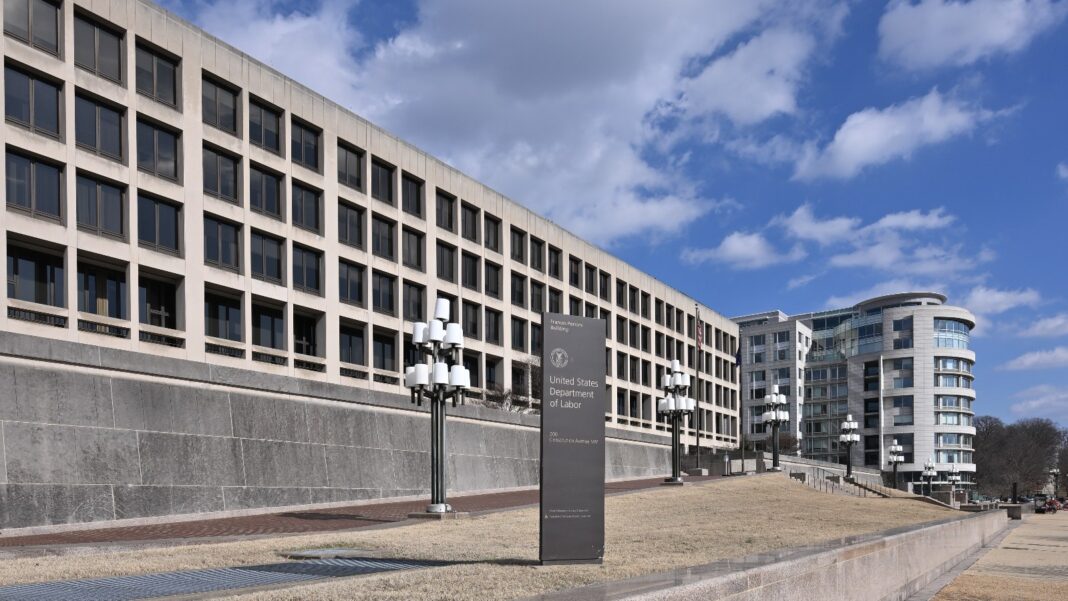
Featured photo: A U.S. Department of Labor sign on Constitution Avenue in front of the Frances Perkins Building in Washington, D.C., photographed Feb. 4, 2025. Photo: G. Edward Johnson, via Wikimedia Commons (CC BY 4.0). Cropped from the original.