


Hiring
September’s jobs report offered little evidence of a broad hiring engine.
U.S. payrolls increased by 29,000 during the month, and the Bureau of Labor Statistics said employment changed little across every major industry.
For job seekers, the composition matters as much as the headline number.
Health care remained one of the few areas showing a continued upward trend, adding 17,000 jobs. Ambulatory health care services added 13,000 and hospitals added 12,000, while nursing and residential care facilities lost 9,000.
Construction added 11,000 jobs, including 12,000 in nonresidential specialty trade contracting. Manufacturing added 9,000.
Financial activities moved in the opposite direction, losing 7,000 jobs during September.
A slower market for outside candidates
The report arrives alongside other evidence that employers are holding onto existing workers while adding new ones cautiously.
Initial unemployment claims were 197,000 in the week ended September 26, and the August JOLTS report showed layoffs and discharges little changed at 1.6 million, a rate of 1.0%.
That can create an unusual recruiting market: people who already have jobs face relatively low risk of losing them, while people looking for a new position encounter fewer rapidly expanding sectors.
September’s industry data reinforce that distinction.
Professional and business services, information, retail, transportation and warehousing, leisure and hospitality, government and several other major industries showed little employment change.
That does not mean employers in those industries stopped recruiting. Payroll employment measures net employment change. Companies can hire thousands of people while other workers leave or other employers reduce headcount.
For candidates, confirmed employer openings and local occupational demand remain more useful than assuming a national industry gain translates directly into available positions.
Where to watch
Health care continues to deserve attention because its employment trend remains positive, even though September’s increase was slower than its average monthly gain of 33,000 over the prior 12 months.
Nonresidential specialty trades are another area to watch. Employment there continued to trend up in September, adding 12,000 jobs, according to BLS.
Manufacturing also bears watching after adding 72,000 jobs since its recent December 2025 low.
But the broad message from September is restraint.
The national labor market is not currently producing a large, economy-wide hiring wave. Workers looking to change jobs may need to focus more closely on occupation, industry and geography than the headline unemployment rate suggests.
Sources
- U.S. Bureau of Labor Statistics, “The Employment Situation — September 2026,” October 2, 2026. https://www.bls.gov/news.release/empsit.nr0.htm
- U.S. Bureau of Labor Statistics, “Job Openings and Labor Turnover — August 2026,” September 29, 2026. https://www.bls.gov/news.release/jolts.nr0.htm
- U.S. Department of Labor, “Unemployment Insurance Weekly Claims,” October 1, 2026. https://www.dol.gov/ui/data.pdf
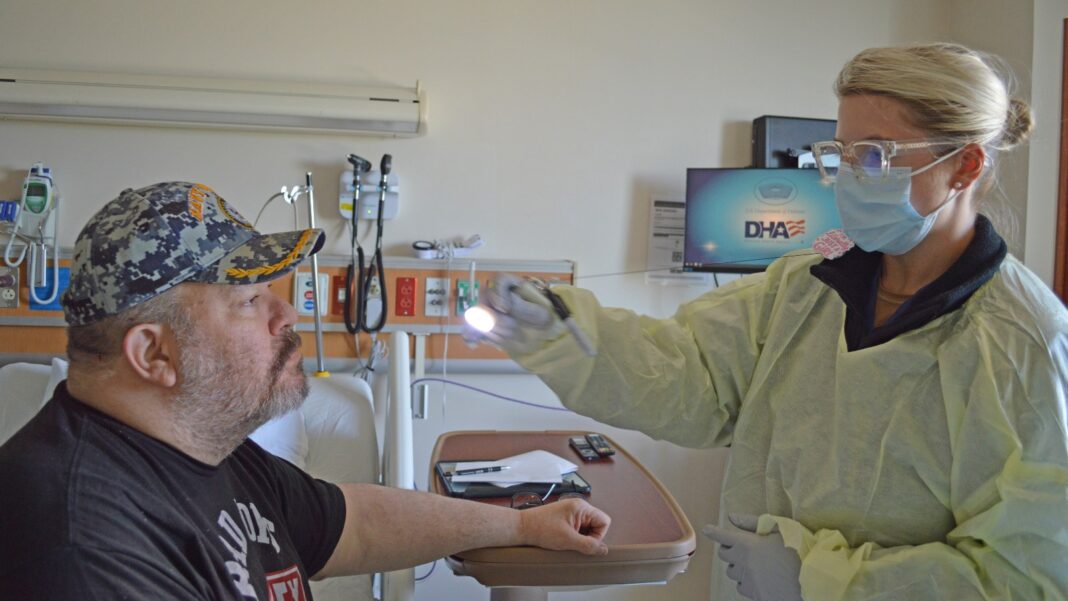
Featured photo: A nurse performs a pupil reaction test on a Department of Veterans Affairs patient at Naval Hospital Jacksonville, Florida, in October 2025. Representative image of health-care work; not connected to the September jobs data. Photo: U.S. Navy (Julie Lucas), via Wikimedia Commons (Public domain). Cropped from the original.





.jpg)