


AI & Work
Microsoft is reorganizing leadership around Office, Teams and Copilot as the company pushes its workplace software toward a more AI-centered operating model.
Microsoft said October 1 that Ryan Roslansky, Microsoft’s executive vice president of LinkedIn and Microsoft 365, is leaving the company after nearly 18 years at LinkedIn and Microsoft. He will stay through the end of the calendar year as an advisor to CEO Satya Nadella to support the transition.
The more consequential workforce-technology development is what happens to the organization after his departure.
Effective immediately, Sumit Chauhan and Lan Ye will report to Charles Lamanna, moving the teams behind Office and Microsoft Teams into what The Verge described as Microsoft’s Copilot, Agents, and Platform organization. Jon Friedman, Microsoft’s chief design officer, will report to Jacob Andreou, whom The Verge described as Microsoft’s Copilot chief. LinkedIn CEO Dan Shapero will continue in that role and report directly to Nadella.
Nadella wrote that Microsoft is “executing rapidly against our vision to build a new OS for work that spans every model, every form factor, and every task, with Office fully embedded in Copilot and vice versa.”
AI is moving into the organizational chart
The change matters because enterprise AI is no longer being managed simply as an additional feature inside existing workplace software.
Microsoft is aligning parts of the organization that build Office and Teams more closely with the teams responsible for Copilot and AI agents.
Nadella credited Roslansky’s team with “bringing together the product, engineering, and design foundations that have made this next phase possible.” Roslansky wrote that “AI was rapidly changing how professionals work,” and that his task had been “figuring out what Copilot, and the future of work, should look like as one ecosystem.”
That is evidence of organizational adoption.
It is not evidence that Copilot has eliminated a particular number of jobs.
Microsoft’s announcement does not attribute Roslansky’s departure to AI. Roslansky said leading the next phase would require “being in Redmond full time, every day,” while his family is in the Bay Area. Neither the announcement nor The Verge’s report mentions layoffs.
The workforce implication is more structural: products used for documents, communication, meetings and collaboration are increasingly being designed around AI-assisted and agentic workflows.
The work questions come next
For employers and workers, the useful questions are now task-level.
Which Office and Teams activities move from user-initiated commands toward agent-managed workflows? Which decisions still require human approval? How do organizations govern access to company data? And what new skills are required when employees supervise automated work rather than execute every step themselves?
Those questions cannot be answered from an organizational chart alone.
But the chart does reveal Microsoft’s direction.
The company is increasingly treating workplace software and AI agents as one product system rather than separate categories.
For a labor market trying to understand AI’s impact, that is a development worth tracking — without confusing product integration with measured job displacement.
Sources
- Microsoft, “Microsoft 365 and LinkedIn leadership update,” October 1, 2026. https://blogs.microsoft.com/blog/2026/10/01/microsoft-365-and-linkedin-leadership-update/
- The Verge, October 1, 2026. https://www.theverge.com/news/1003515/microsoft-ryan-roslansky-office-teams-linkedin-leaving
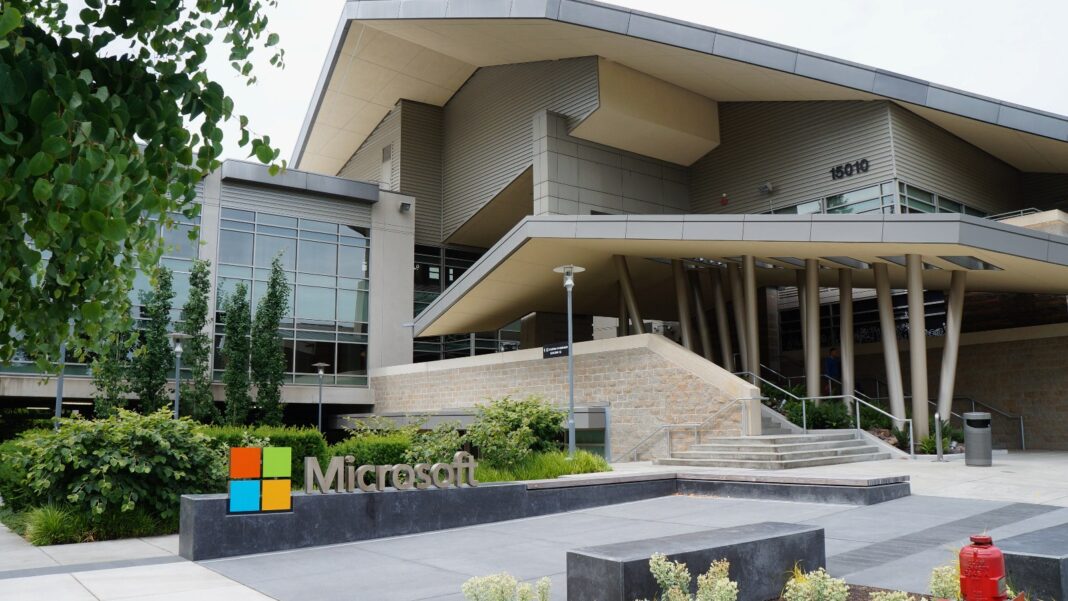
Featured photo: Building 92 on Microsoft’s campus in Redmond, Washington. Photo: Jiaqian AirplaneFan, via Wikimedia Commons (CC BY 3.0). Cropped from the original.




