
Occupational AI exposure scores have become a common starting point for discussions about which jobs artificial intelligence will affect. They are useful. They are also routinely asked to answer questions they were not built to answer. Two recent papers from the Stanford Digital Economy Lab make the limits unusually concrete: occupations with similar exposure show very different employment outcomes depending on who holds the job and how the technology is used.
What an exposure score actually measures
One widely used measure comes from Eloundou and co-authors (2024). As described in a new Stanford working paper, it rates each of the 19,265 tasks in the O*NET occupational database on whether a large language model by itself, or with additional software built on top, could cut the time a worker needs to perform the task in half at equal quality. Task ratings are then aggregated to occupations.
That is a measure of technical potential. It does not record whether any employer has adopted the technology, whether the time saved is used to cut staff or to produce more, or who within an occupation is affected. The authors of the working paper, “How Does AI Change Labor Demand? Evidence from 41 Countries,” put it plainly in their conclusion: “Exposure scores cannot settle the question, because they measure the potential for labor-saving and labor-expanding uses alike.”
Same exposure, different outcomes
The evidence shows at least three ways in which exposure alone misses the story.
Seniority. In the August 2026 revision of “Canaries in the Coal Mine?”, Erik Brynjolfsson, Bharat Chandar and Ruyu Chen found that employment of workers ages 22 to 25 in highly AI-exposed occupations stood about 19% below where it would have been had it kept pace with similarly aged workers in less-exposed occupations, based on ADP payroll data through June 2026. Experienced workers showed no comparable gap. The occupations were the same; the outcomes differed by career stage.
How AI is used. The same study used data from the Anthropic Economic Index, which classifies usage of an AI model as either substituting for or complementing human work. The declines were concentrated in occupations where AI usage tends to automate tasks. Where AI is used more to complement workers, employment was flat or rising. Two occupations with similar exposure scores can sit on opposite sides of that line.
Firm adoption. The 41-country paper, by Chandar and Bouke Klein Teeselink, looked inside companies that adopted generative AI, using job postings to identify adopters. At adopting firms’ foreign affiliates, the authors estimate that adoption shifted senior employment toward the most AI-exposed occupations by 5% relative to less-exposed seniors, while shifting junior employment away from the most-exposed occupations by 2%. Exposure was associated with more demand for one group and less for another within the same firms.
The most exposed occupational group in that study makes the point sharply. Computer and mathematical occupations, the most AI-exposed of 22 groups, saw their share of employment at adopting affiliates rise by 0.8 percentage points relative to controls, while the junior share within those occupations fell by 3.3 points. A ranking that simply flagged the group as “most at risk” would have missed that it grew.
The measurement cautions
None of this makes exposure scores wrong. The Canaries authors report that their young-worker pattern holds across alternative exposure measures, which suggests the scores capture something real. But several cautions apply before exposure data are used in workforce decisions.
- The findings are descriptive. The Canaries authors describe their results as “descriptive patterns, not causal estimates of the effect of AI,” and note that gaps shrink when education is taken into account and that some divergent trends predate generative AI.
- Usage-based measures change. The Anthropic Economic Index measures shift as usage evolves; the Canaries paper reports results from several releases.
- Mapping jobs to scores is itself a step. Exposure scores attach to standard occupation codes, not to an employer’s job titles. The Canaries team had to map ADP job titles to Standard Occupational Classification codes and crosswalk between code vintages, and job titles were missing for roughly 30% of their sample. Any employer applying published scores to its own roles faces a similar translation problem, and should document it.
- Samples differ. The ADP analysis sample over-represents larger firms and more-exposed occupations; the 41-country data describe multinational affiliates visible on LinkedIn.
A layered approach for employers
The practical lesson is to treat exposure as the first layer of an analysis rather than its conclusion. A workforce dashboard built on this research would keep separate, clearly labeled layers:
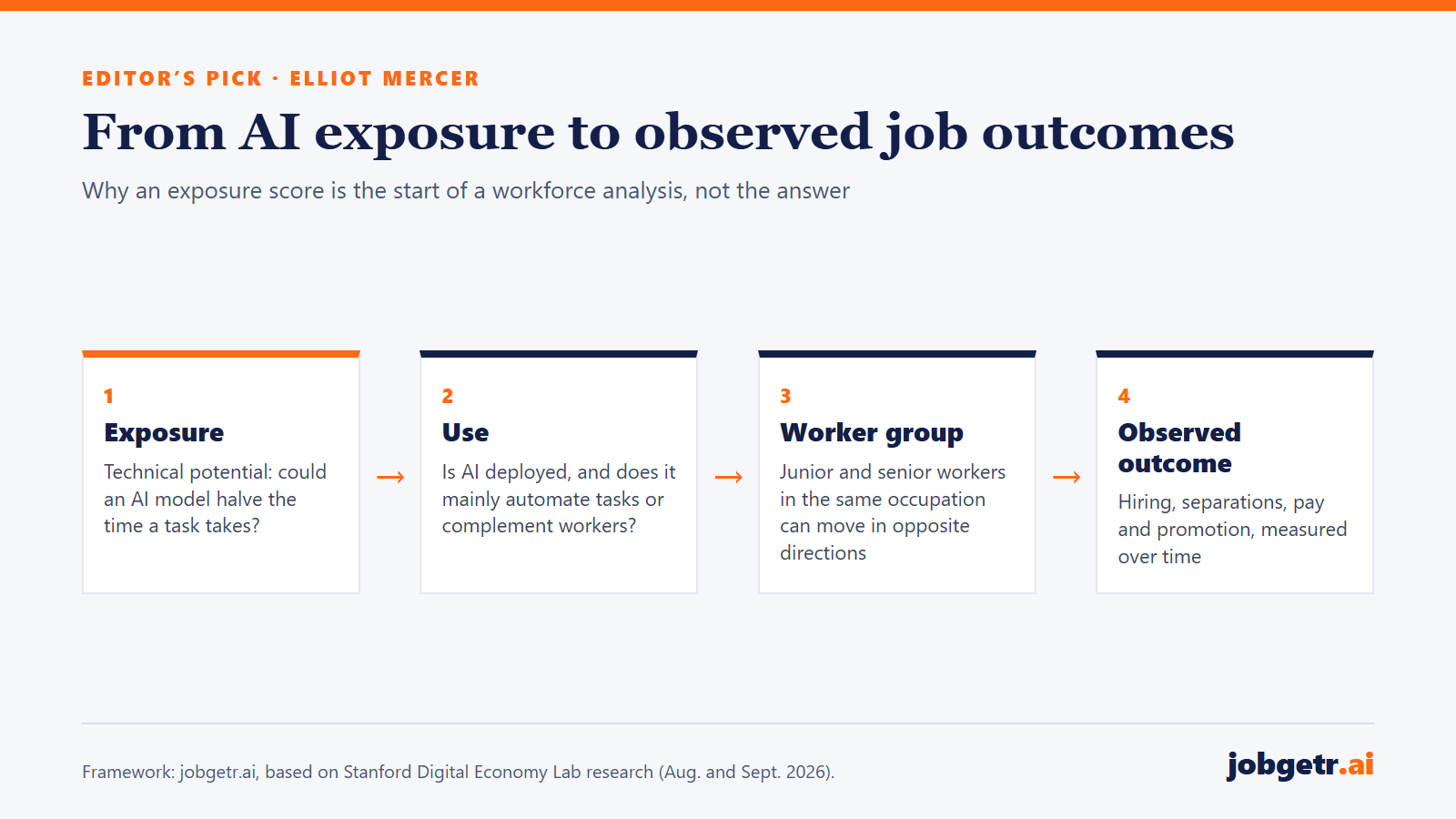
- Exposure: the technical potential of tasks in a role, from a documented published measure.
- Use: whether AI is actually deployed in the work, and whether it mainly automates tasks or supports people doing them.
- Worker group: outcomes split by seniority, since junior and senior workers in the same occupation moved in different directions in both studies.
- Observed outcomes: hiring, separations, pay and promotion over time.
Keeping the layers separate matters because they answer different questions. A high exposure score is a reason to look more closely at a role. It is not evidence that the role will shrink, and it says nothing about whether the people in it will be displaced, retrained or promoted.
For workers, the same logic applies. An occupation’s exposure score is a weak guide to one’s own prospects. The research suggests that career stage and the way AI is used in a given workplace matter at least as much.
What to watch next: whether future versions of these studies continue to find that the automation-versus-complement split explains more than exposure alone, and whether published data on firm-level AI use become detailed enough to test that directly across more of the U.S. economy.
Sources
- Stanford Digital Economy Lab (Chandar, Klein Teeselink), “How Does AI Change Labor Demand? Evidence from 41 Countries (publication page),” 2026-09-21.
- Stanford Digital Economy Lab (Chandar, Klein Teeselink), “How Does AI Change Labor Demand? Evidence from 41 Countries (working paper PDF),” 2026-09-20.
- Stanford Digital Economy Lab, “No Widespread Displacement, but the AI Employment Gap for Young Workers Has Widened to 19%,” 2026-08-12.
- Stanford Digital Economy Lab (Brynjolfsson, Chandar, Chen), “Canaries in the Coal Mine? Six Facts about the Recent Employment Effects of Artificial Intelligence (revised paper),” 2026-08.
Featured photo: Stanford University, home of the Digital Economy Lab whose research this article examines. Photo: Frank Schulenburg, via Wikimedia Commons (CC BY-SA 4.0). Resized from the original.