
AI & Work
A widely cited estimate of how many American workers would struggle to adapt if AI displaced them has been revised down in the study’s final published version. The chapter, “How Adaptable Are American Workers to AI-Induced Job Displacement?” by Sam Manning and Tomás Aguirre, now appears in the National Bureau of Economic Research volume The Economics of Transformative AI. It puts 3.3 million workers, or 2.5% of the workforce in its sample, in occupations that are both highly exposed to AI and low in adaptive capacity.
What changed from the January version
The research first circulated in January 2026 as NBER Working Paper 34705. That version covered 356 occupations representing 95.9% of the U.S. workforce. It found 37.1 million workers in the top quartile of AI exposure, 26.5 million of them in occupations with above-median adaptive capacity, and 6.1 million workers (4.2%) in occupations that combined high exposure with low adaptive capacity.
The September 2026 chapter uses a narrower set of 300 occupations covering 91.9% of the workforce. It counts 34.7 million workers in the top exposure quartile and 23.9 million of them in occupations with above-median adaptive capacity. The high-exposure, low-capacity group falls to 3.3 million. The chapter summary does not detail every methodological change between versions. Readers comparing the two sets of numbers should treat them as different estimates, not as a change in the labor market between January and September.
Who is in the vulnerable group
Both versions reach the same broad conclusion: high AI exposure and adaptive capacity tend to go together. Many exposed occupations are filled by workers with relatively strong means to manage a job change if displaced. The workers who combine high exposure with low adaptive capacity are concentrated in clerical, administrative-support and assistance roles, according to the chapter summary.
That framing treats AI risk as an occupational transition problem rather than a single number. A highly exposed professional with transferable skills may need different support from an administrative worker with narrow credentials and fewer local alternatives.
What the index is not
Adaptive capacity is an occupation-level measure, not a forecast that any individual worker will or will not change jobs successfully. AI exposure is a measure of potential task overlap, not observed displacement. Personal finances, age, caregiving, employer support and licensing rules can make a transition easier or harder than an occupation score suggests. Exposed occupations may grow, shrink or simply change their mix of tasks.
For workforce programs, the practical lesson is to tie training to realistic nearby occupations, local wages and demand rather than to generic AI courses. For workers in administrative roles, the useful questions are which of their tasks are changing and which adjacent roles already use their skills.
Sources
- Sam Manning and Tomás Aguirre, “How Adaptable Are American Workers to AI-Induced Job Displacement?” in The Economics of Transformative AI, National Bureau of Economic Research, September 2026. https://www.nber.org/books-and-chapters/economics-transformative-ai/how-adaptable-are-american-workers-ai-induced-job-displacement
- Sam J. Manning and Tomás Aguirre, “How Adaptable Are American Workers to AI-Induced Job Displacement?” NBER Working Paper 34705, January 2026. https://www.nber.org/papers/w34705
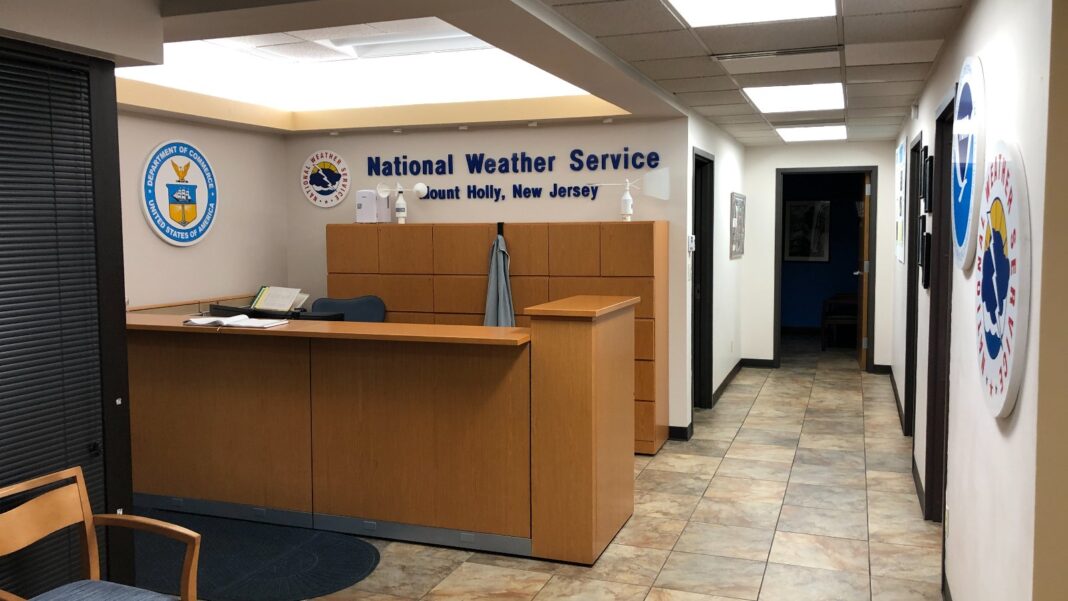
Featured photo: An administrative support desk at a federal office in New Jersey. Representative image; clerical and administrative roles are concentrated in the study's most vulnerable group. Photo: Famartin, via Wikimedia Commons (CC BY-SA 4.0). Cropped from the original.