


Employers & Industry
A company-backed workforce model released Monday projects that the U.S. healthcare workforce shortage is “on track to nearly double by 2040” if current patterns hold. The Covista Healthcare Workforce Index is based on a model by the consulting firm Oliver Wyman. It draws on “more than 60 academic, government, industry and business data sets and interviews with health system leaders,” according to the company’s Business Wire release.
Covista is the new name, adopted in February, of Adtalem Global Education. The for-profit company owns Chamberlain University, Walden University and several medical and veterinary schools, and describes itself as America’s largest healthcare educator. Its business depends on demand for healthcare training, which readers should keep in mind when weighing a model that recommends expanding that training.
What the model projects
The release says a combined approach, pairing workforce investment with changes in how care is delivered, could close 92% of the projected gap. Supply actions alone could close over half of the 2040 gap: attracting talent accounts for up to 7%, developing talent for 25% and retaining talent for about 25%. The company says closing the nursing shortage could save nearly 100,000 lives cumulatively by 2040. It also says closing the physician gap could add more than six months to average life expectancy and cut wait times for specialist care by 20%.
The release puts the cost of unfilled positions to the average U.S. family at about $430 a year today, rising to $1,250 a year by 2040. It also says nursing schools turned away roughly 93,000 qualified applications in 2025. The release does not publish an absolute number of workers the gap represents today or in 2040.
Modeled scenarios, not observed data
These are projections under stated assumptions, not observed outcomes or a Bureau of Labor Statistics forecast. The release says the model treats headwinds and care-delivery innovation at their most likely scenario but models supply actions “at the best case.” The 92% figure is therefore an optimistic scenario for training and retention. Results depend on assumptions about demand, productivity, training capacity and technology.
What employers can take from it
Healthcare staffing depends on more than recruiting. Education slots, clinical placements, faculty, licensing, retention and geography all constrain supply. Technology can change how clinicians spend their time, but it can also create new coordination and supervisory work rather than simply reducing demand for labor.
Hospitals and health systems can treat the model as one input for scenario planning. Local openings, turnover, wages and training completions will show which occupations are actually constraining care in a particular market, and those can differ sharply from a national projection.
Sources
- Covista, “The Healthcare Workforce Gap Is Set to Nearly Double by 2040” (Business Wire), September 28, 2026. https://www.businesswire.com/news/home/20260928447812/en/The-Healthcare-Workforce-Gap-Is-Set-to-Nearly-Double-by-2040
- Adtalem Global Education, “Adtalem Global Education Becomes Covista” (Business Wire), February 5, 2026. https://www.businesswire.com/news/home/20260205325750/en/Adtalem-Global-Education-Becomes-Covista
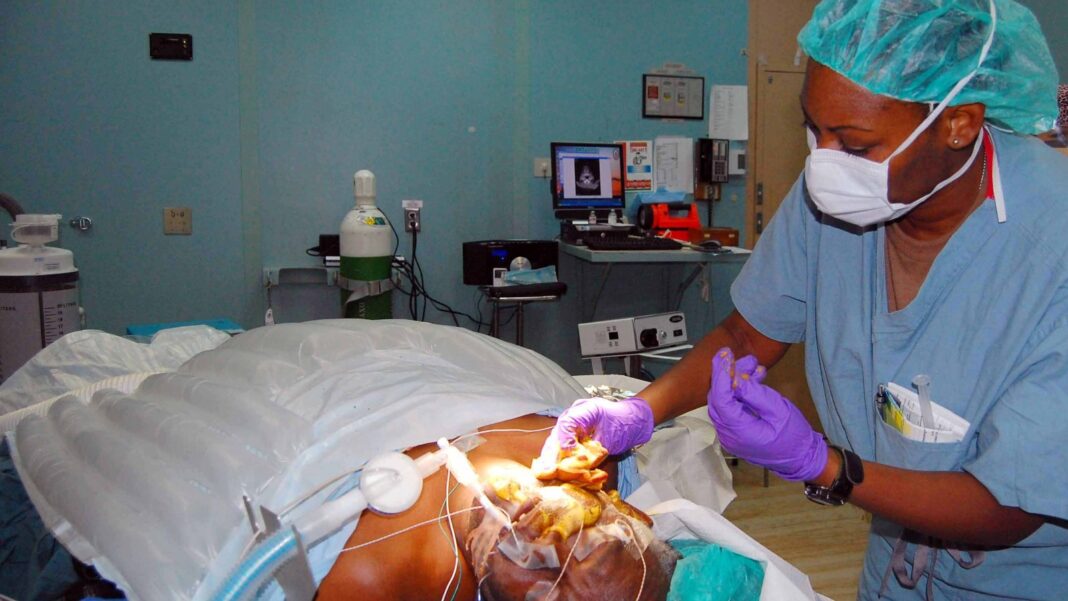
Featured photo: A U.S. Navy nurse prepares a patient for surgery aboard the hospital ship USNS Comfort in 2009. Representative image; not connected to the Covista model. Photo: U.S. Air Force photo by Airman 1st Class Ashley Garcia (U.S. Navy release), via Wikimedia Commons (Public domain). Cropped from the original.





,_cleans_and_prepares_a_patients_skin_for_surgery.jpg)