
Research & Data
A new discussion paper complicates the claim that AI has already produced an unemployment shock for new college graduates. In IZA Discussion Paper No. 18945, published in September, economists Robert Fairlie of UCLA and Jane Wu of UCLA use Current Population Survey microdata through August 2026. They report that unemployment among recent college graduates “did not spike in summer 2026 relative to summer months in previous years and did not rise in a significant way relative to older college graduates or young workers without a college degree.”
What the paper measured
The authors define recent graduates as people ages 22 to 25 whose highest degree is a bachelor’s and who are not enrolled in school. They compare them with college graduates ages 30 to 49 and with young workers without a degree, using difference-in-differences and event-study models on CPS data from January 2022 to August 2026.
On the official measure, recent-graduate unemployment averaged 7.3% in June through August 2026, compared with 7.2% in summer 2025, 7.8% in 2024, 6.3% in 2023 and 7.1% in 2022. Monthly, it rose from 5.4% in May to 7.8% in June before easing to 7.4% in July and 6.8% in August. Older graduates’ unemployment moved from 2.7% to 2.8% between the two most recent summers, so the gap between the groups held at about 4.5 percentage points.
Where the results are less reassuring
The paper also tests a broader measure that adds people who say they want a job, whom the authors call the “sidelined unemployed.” That adds nearly two percentage points to recent graduates’ rate. Summer 2026 was the highest of the five summers on this measure, at 10.4%, though only 0.3 points above the previous high, and the increase was not statistically significant. The authors write that there “might be a deterioration in the relative position of young graduates compared with 2025.”
When the authors interacted 2026 unemployment with occupational AI exposure, the estimates were consistently positive but none were statistically significant. They did find statistically significant, positive estimates for occupations where remote work is more feasible. Because remote-capable and AI-exposed occupations overlap heavily, they say the two explanations are hard to separate.
What not to conclude
This is a discussion paper; IZA notes that such papers present preliminary work that may be revised. It covers one summer and one measure of labor-market distress. It does not show that AI has no effect on early-career work, and effects could appear first in hiring rates, job quality or particular fields. Stanford Digital Economy Lab research using ADP payroll data, for example, has found a widening employment gap for workers ages 22 to 25 in highly AI-exposed occupations, operating mainly through reduced hiring. The IZA authors themselves say their findings do not rule out larger effects for later graduating classes.
What to watch
Following the same graduates over a longer period, and linking unemployment with hiring rates, occupations, fields of study and wages, will say more than any single summer.
Sources
- Robert W. Fairlie and Jane Wu, “The Early Impacts of AI on Employment among Recent College Graduates,” IZA Discussion Paper No. 18945, September 2026. https://www.iza.org/publications/dp/18945/the-early-impacts-of-ai-on-employment-among-recent-college-graduates
- Full paper (PDF). https://docs.iza.org/dp18945.pdf
- Stanford Digital Economy Lab (Erik Brynjolfsson, Bharat Chandar, Ruyu Chen), “Canaries in the Coal Mine? Six Facts about the Recent Employment Effects of Artificial Intelligence,” revised August 12, 2026. https://digitaleconomy.stanford.edu/publication/canaries-in-the-coal-mine-six-facts-about-the-recent-employment-effects-of-artificial-intelligence/
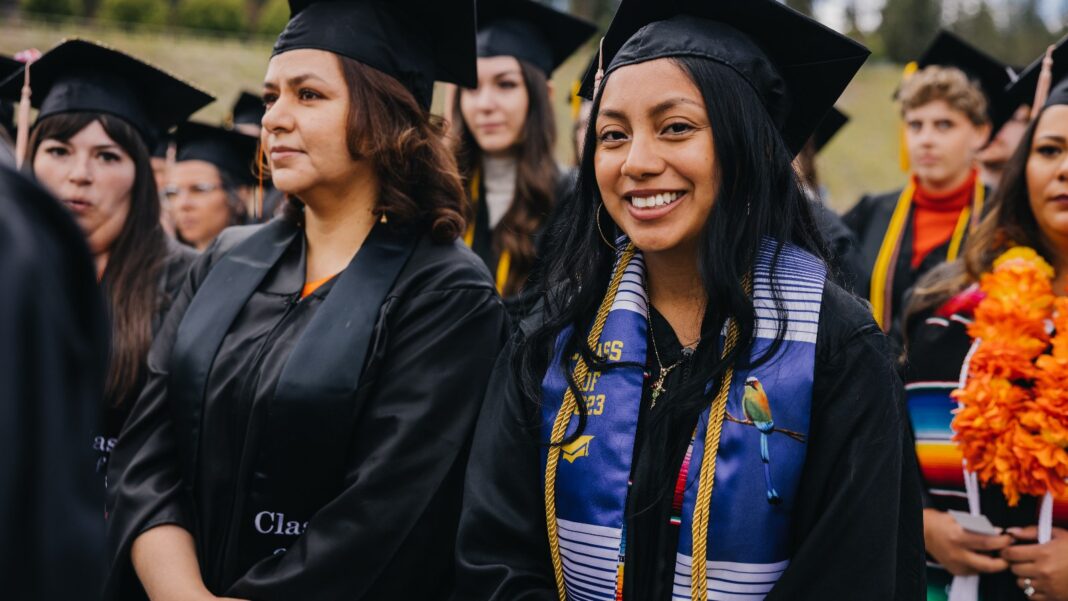
Featured photo: Graduates at Oregon State University–Cascades’ 2023 commencement. Representative image; the graduates pictured are not respondents in the survey data discussed. Photo: Oregon State University, via Wikimedia Commons (CC BY-SA 2.0). Cropped from the original.