
Careers & Skills
Coursera’s 2026 Global Skills Report, released September 29, argues that AI skills are worth more when they are paired with human skills such as critical thinking. The report, the eighth edition, combines learning data from Coursera and Udemy for the first time, covering more than 300 million learners across 98 countries. It also introduces an AI-Human Skills Synergy Index.
What the report found
The United States ranks eighth globally on the new index, which Coursera says measures how far national populations are developing AI skills alongside the human skills needed to apply them. The index combines a subset of Coursera and Udemy learner data with Oxford Insights’ Government AI Readiness Index. Germany, France and Japan rank first through third.
The U.S. scores first on the report’s indicator of broader policy, infrastructure and technology readiness, but ranks 27th of 98 countries on Coursera’s assessment of learner proficiency and behavior. “The US has built the infrastructure and policy foundation to lead the world on AI, but our data shows the workforce hasn’t caught up,” said Anthony Salcito, Coursera’s president of enterprise.
Among U.S. learners, Coursera reports that enrollments in AI security rose 358% year over year, and critical-thinking enrollments rose 206%. Globally, critical-thinking enrollments rose 107%, and learners enrolled in generative-AI content at a combined rate of more than 45 enrollments a minute, up from 25 a minute in 2025. U.S. enrollments in AI-focused micro-credentials rose 84%, Coursera says.
Why it matters for careers
The career signal in the report is that using AI tools and judging their output are becoming a pair. Critical thinking, communication, domain knowledge and security practices complement automation when a worker has to decide whether a generated answer is accurate, appropriate and safe to use.
What not to conclude
This is platform data and a Coursera-designed index, not a representative survey of the U.S. workforce. Enrollment growth shows what learners on these platforms chose to study, not whether employers hired them afterward or whether a course produced job-ready skill. Coursera recently combined with Udemy, so the Udemy data is not an independent check. The public materials do not explain how the index components are weighted; the full report is behind a registration form.
What to watch
For workers, the better test of a skill is whether it shows up in real job requirements and projects, not only in course popularity. Employers can compare their own skill gaps with these learning trends and then check whether training changes performance, internal mobility or hiring outcomes.
Sources
- Coursera, “Global Skills Report 2026,” report landing page, accessed September 29, 2026. https://www.coursera.org/ent-website/skills-reports/global
- Coursera press release via Business Wire on the AI-Human Skills Synergy Index, September 29, 2026 (FinancialContent copy). https://www.financialcontent.com/article/bizwire-2026-9-29-us-ranks-eighth-globally-for-ai-preparedness-in-courseras-new-ai-human-skills-synergy-index
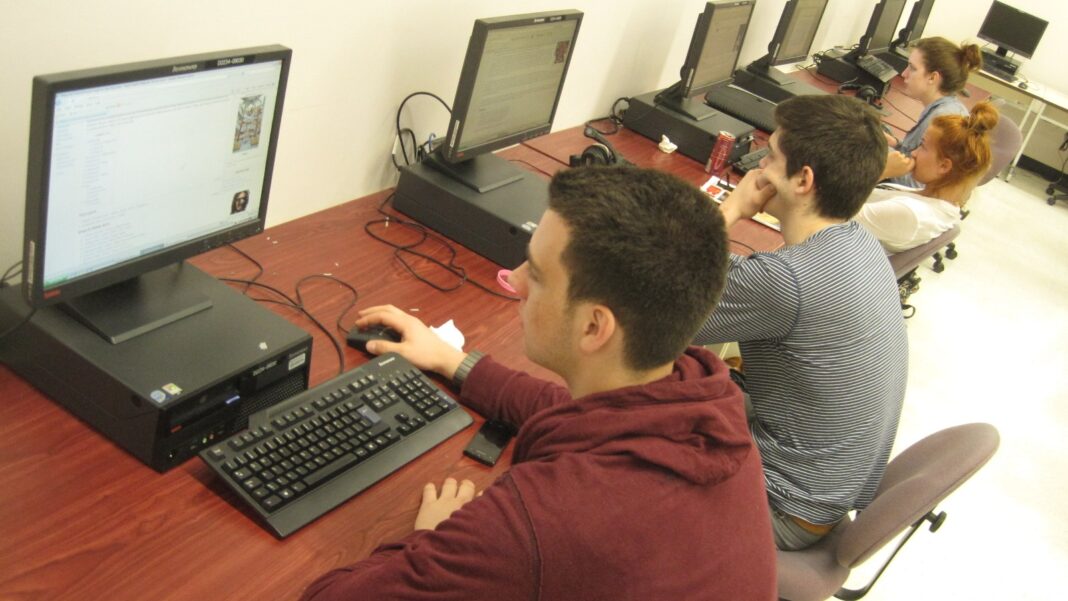
Featured photo: Students work in a computer lab at the Cégep de Saint-Hyacinthe in Quebec in 2013. Representative image of learners; the students pictured are not connected to Coursera’s report. Photo: MCPearson, via Wikimedia Commons (CC BY-SA 3.0). Cropped from the original.