
By the Numbers
The U.S. current-account deficit widened by $33.4 billion, or 15.7%, to $246.0 billion in the second quarter of 2026, the Bureau of Economic Analysis reported September 24. The first-quarter deficit was revised to $212.6 billion. As a share of current-dollar gross domestic product, the deficit rose to 3.0% from 2.7%. The current account measures trade in goods and services plus income and transfers; it does not show how many American workers were hired or laid off.
What drove the change
The widening “reflected an expanded deficit on goods that was partly offset by reduced deficits on primary (earned) income and on secondary income (current transfers),” according to BEA. Exports of goods and services plus income received rose $58.8 billion to $1.44 trillion, while imports plus income paid rose $92.2 billion to $1.69 trillion.
A larger goods deficit can reflect many forces: stronger domestic demand pulling in imports, weaker foreign markets for U.S. exports, or shifts in prices. It is not sound to convert it directly into an estimate of lost factory jobs. A manufacturer importing equipment to expand U.S. production, for example, may raise imports temporarily while preparing to hire.
The investment position
BEA also updated the net international investment position, the difference between U.S. residents’ foreign financial assets and their liabilities to the rest of the world. It stood at −$22.42 trillion at the end of the second quarter, compared with a revised −$21.27 trillion at the end of the first. U.S. assets rose $3.72 trillion to $46.97 trillion, and liabilities rose $4.87 trillion to $69.39 trillion; most of each increase came from price changes rather than new transactions. This is a stock of financial claims, distinct from the quarterly flow the current account measures.
Connecting trade to jobs
Both measures can matter to the job economy through export demand, investment costs and industry exposure, but neither identifies which occupations gained or lost employment. That requires industry trade data, production, business investment and payroll records, and even then several forces operate at once. A single deficit reading cannot explain a staffing decision.
The next international transactions release, covering the third quarter, is scheduled for December 18.
Sources
- U.S. Bureau of Economic Analysis, “U.S. International Transactions and Investment Position, 2nd Quarter 2026,” September 24, 2026. https://www.bea.gov/news/2026/us-international-transactions-and-investment-position-2nd-quarter-2026
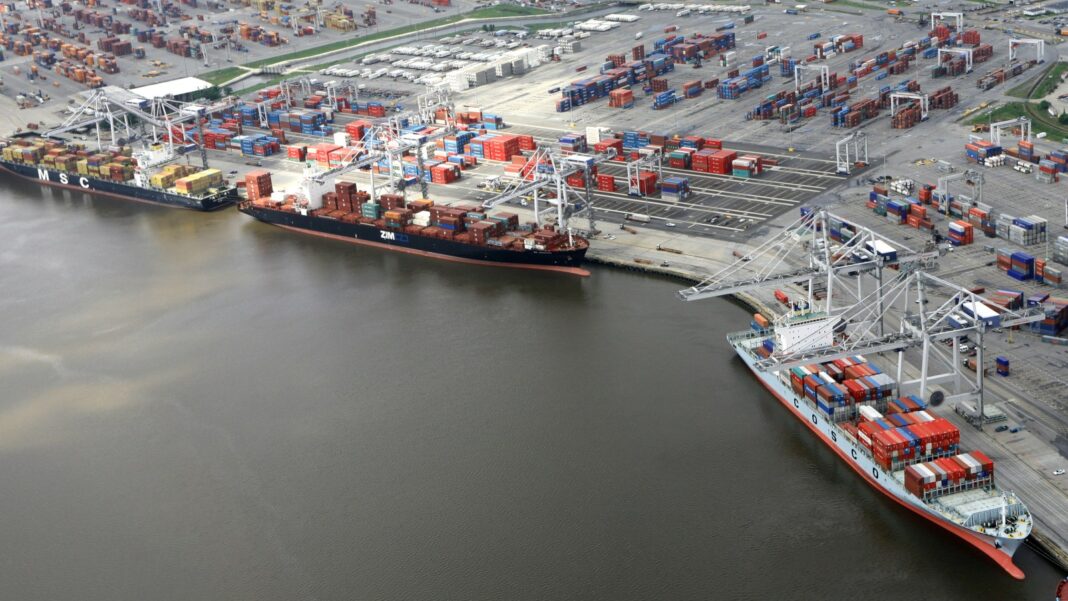
Featured photo: Container ships at the Port of Savannah, Georgia. Representative image of U.S. international trade. Photo: U.S. Army Corps of Engineers, via Wikimedia Commons (Public domain). Cropped from the original.